






A few weeks ago I watched a video discussing yet another split among Reformed Christians. The men had a podcast and YouTube channel together, differences arose, and one was allegedly forced out. We will never know the complete truth of what happened, but it was clear the disagreement was not over primary issues. It was over secondary or even tertiary issues.
In the video, someone used the phrase “guardrails become guillotines” when discussing this particular situation. It jumped out at me because it was the perfect encapsulation of what I had been observing about other issues in the body of Christ.
Guardrails Become Guillotines
In that setting, the guardrails referred to the creeds and confessions. The speaker’s point was that the guardrails (creeds and confessions) are now being used as guillotines to cut people off on matters not historically considered heresy.
Because of this and other happenings I had been observing over the last year, I decided it was important to be clear on what heresy actually is as well as the role creeds and confessions should or should not play in the life of a Christian. I’ve written recently about the idea that pastors and theologians are Theologically Trapped By Denominational Confessions and Creeds and what it can mean to subscribe to a particular church’s teaching in C. S. Lewis on Not Submitting to Future Church Decisions and Doctrines.
I’ve also shared several videos and posts by people who consider themselves preterists (both partial and full). One even jokingly calls her YouTube channel Heretic Chick Chat. She named it that tongue-in-cheek because she knew being a preterist would lead to people calling her a heretic. But is she? Is she changing the message of Jesus Christ and salvation? No. She has a different understanding of how the prophesies have unfolded, but she’s never denied that salvation is by faith in Jesus Christ alone. So what am I to make of my preterist brothers and sisters in Christ who present a compelling argument for their theological views? How do I respond when people call preterism heresy?
Here’s a comment I saw just last evening under a video about whether or not women can speak in church.
You denied in this film Orthodoxy of Christanity on matter of Male and woman Authority in the church, this elimantes you as heretic from any christian communion. For only men can be in position of aithority and teach – speak – in the church, and anyone who says difrently is from the evil one.
So if you hold a different view of women speaking in the church this man is completely ready to label you a heretic.
That’s just one example of how casually this word is thrown around these days.
Martin Luther, Heretic
One thing I’ve kept in the back of my mind in the midst of all this is the fact that Martin Luther was condemned by the religious authorities a heretic. After 1,500 years of adherence to the same beliefs, someone stood up and said that he thought the church was wrong on a number of issues. For this, he was considered heretical (and still is by the Roman Catholic church). The Christian faith many of us live today was shaped by that “heretical” act that wasn’t “allowed” by the church.
That should give all of us who are Protestants, Evangelicals, and Baptists pause because we would not consider Luther a heretic.
Is it possible the body of Christ still holds to beliefs that are incorrect another 500 years later?
It took 1,500 years for Luther to call out just some of the errors. Are there more? Are we allowed to ask? Are we allowed to make arguments from the Scripture that contradict the Protestant creeds and confessions?
What’s ironic is that some of the most vocal people eagerly calling out perceived heresy today are of the Reformed camp. Yet their very own confessions state that they are not infallible and they have been changed at times. But anyone even suggesting today that perhaps there are other errors on secondary matters that should be looked at more closely is cut off. The questioner is summarily given the proverbial fellowship guillotine.
So is heresy serious? Yes, of course. Wrong beliefs can lead someone away from salvation in Jesus Christ.
However, the label of heretic can also be wrongly applied. My concern is that the term is being thrown around an awful lot in Protestant, Evangelical, and Baptist circles to the point that it is becoming useless. Now when something truly is heretical and is called out, the word has almost no meaning.
What is Heresy?
So first is to find a definition of heresy. Even this varies widely. Here are a few examples just to illustrate this.
Here is the Wikipedia definition.
Heresy (in Christianity) is used today to denote the formal denial or doubt of a core doctrine of the Christian faith as defined by one or more of the Christian churches. It is distinguished from both apostasy and schism, apostasy being nearly always total abandonment of the Christian faith after it has been freely accepted, and schism being a formal and deliberate breach of Christian unity and an offense against charity without being based essentially on doctrine.
Here is what Christianity.com says.
Heresy is any belief or theory that strongly opposes established beliefs or customs, particularly the accepted beliefs or religious law of a religious organization. Within Christianity, it is any belief or practice that explicitly undermines the gospel. It is a threat to the unity and orthodoxy of the faith, and historically, the identification and condemnation of heresies have played a significant role in shaping the development of Christian theology.
According to Easton’s Bible Dictionary, the word heresy comes from a Greek word, meaning a self-chosen opinion or the sect holding that opinion. Heresies came to be understood as self-chosen doctrines that do not originate from God.
Heretical beliefs are considered a departure from the accepted and authoritative teachings of Christian tradition. Heresy is typically an internal challenge within a religious community, as it pertains to deviations from official doctrines. The identification and condemnation of heresy have historically been addressed through theological debates, councils, and doctrinal statements.
Michael Horton on the website Modern Reformation offers this definition:
The first question proposed in the title of this article is, “What is heresy?” The answer is, “Any teaching that directly contradicts the clear and direct witness of the Scriptures on a point of salvific importance.” In other words, there may be teachings that are strange, such as Benny Hinn’s suggestion that before the Fall, Adam could fly and remain for hours under water, or teachings that we may regard as clearly contrary to the biblical texts. But since they do not touch upon a key doctrine of God, human nature, Christ’s person and work, the Holy Spirit, or salvation, they may be erroneous, but they are not heretical. For centuries, theologians have distinguished between formal heresy, which is the persistent and stubborn denial of a fundamental doctrine, even though one has been instructed in the truth, and material heresy, in which one embraces a doctrine that is itself heretical, but embraces it in ignorance. The Greek word hairesis literally means “that which is chosen by and for oneself,” and Paul employs it concerning false teachers who bring division (1 Cor 11:19 and Gal 5:20). In other words, heresy brings with it not only error, but a particular spirit or attitude: arrogance, a rejection of all authority, and self-will. These have always been considered the vices of heresy, but in modern liberalism and evangelicalism they are often regarded as signs of special enlightenment or novel insights that have escaped the darkened wits of past generations.
Anyone who denies the existence of such a thing as heresy denies the possibility of a religion having any boundaries. If a religion does not have any boundaries, distinguishing Christianity from Hinduism or atheism is meaningless.
Ligonier has a video about heresy with this description.
Some people use the word heresy simply to mean any error or a fairly serious error in theology. But classically the word heresy was used to describe those theological errors so serious that it would deprive one of salvation. I think we ought to be using heresy more in that sense.
Error is error. Error can be serious. Error can be small. Error is always bad, and to be avoided. But there are some errors that are so huge that they really are cutting us off from God, because we have so misunderstood Him and His truth. And that’s what heresy classically was used for in the church.
The Catholic Encyclopedia explains it this way.
Heresy differs from apostasy. The apostate a fide abandons wholly the faith of Christ either by embracing Judaism, Islamism, Paganism, or simply by falling into naturalism and complete neglect of religion; the heretic always retains faith in Christ. Heresy also differs from schism. Schismatics, says St. Thomas, in the strict sense, are they who of their own will and intention separate themselves from the unity of the Church. The unity of the Church consists in the connection of its members with each other and of all the members with the head. Now this head is Christ whose representative in the Church is the supreme pontiff. And therefore the name of schismatics is given to those who will not submit to the supreme pontiff nor communicate with the members of the Church subject to him. Since the definition of Papal Infallibility, schism usually implies the heresy of denying this dogma. Heresy is opposed to faith; schism to charity; so that, although all heretics are schismatics because loss of faith involves separation from the Church, not all schismatics are necessarily heretics, since a man may, from anger, pride, ambition, or the like, sever himself from the communion of the Church and yet believe all the Church proposes for our belief (II-II, Q. xxix, a. 1). Such a one, however, would be more properly called rebellious than heretical.
The dispensational website Got Questions has this to say.
Of course, not every disagreement in the church is heresy. Having a different opinion is not wrong, but when the opinion is divisive or maintained in defiance of clear biblical teaching, it becomes heretical. The apostles themselves disagreed at times (see Acts 15:36-41), and Peter once had to be rebuked for divisive and legalistic behavior (Galatians 2:11-14). But, praise the Lord, through an attitude of humility and submission to the God of truth, the apostles worked through their disagreements and set an example for us.
So there are several explanations of heresy from different sources and theological perspectives. Let’s try to bring them together for our purposes.
What Constitutes Heresy in the Christian Faith?
Heresy in Christian theology refers to teachings or beliefs that fundamentally contradict core doctrines established in Scripture and affirmed by historic creeds. It is a departure from essential truths necessary for orthodox Christian belief, not merely differences of opinion on secondary matters.
Historically significant heresies include:
- Arianism: Denial of Christ’s full divinity and eternal nature
- Docetism: Rejection of Christ’s genuine humanity
- Pelagianism: Claiming salvation through human effort rather than divine grace
- Nestorianism: Improper separation of Christ’s divine and human natures
The early church addressed these issues through ecumenical councils that carefully determined biblical boundaries (guardrails) to preserve sound doctrine. While Christianity allows liberty on non-essential matters, heresy strikes at the foundation of gospel truth. For that reason, it has traditionally been met with corrective teaching and church discipline to protect believers from spiritual deception.
True heresy is related to distortions of essential doctrines including the Trinity, the nature of Christ, the means of salvation, and the authority of Scripture. Why? Because these ultimately determine whether one is teaching the Christian gospel or another message entirely.
The Centrality of Christology in Identifying Heresy
The central battleground for Christian orthodoxy has always been the doctrine of Christ (Christology). The vast majority of historic heresies and all major cults fundamentally distort the person and work of Jesus Christ. In fact, the easiest way to identify a cult is to look at what they teach about Jesus. They always tinker with that aspect of the faith.
We see from the example of the Apostles the importance of confronting early deviations from sound teaching about Christ. John offers this warning in 1 John 4:1-4.
Beloved, do not believe every spirit, but test the spirits to see whether they are from God. For many false prophets have gone out into the world. By this you will know the Spirit of God: Every spirit that confesses that Jesus Christ has come in the flesh is from God, and every spirit that does not confess Jesus is not from God. This is the spirit of the antichrist, which you have heard is coming and which is already in the world at this time.
Essential components of orthodox Christology that heresies typically attack include:
- Pre-existence and Deity: That Christ is eternal God, the Second Person of the Trinity and not a created being (contradicted by Arianism and held by modern groups like Jehovah’s Witnesses)
- True Incarnation: That He became fully human with a real human body and soul (denied by Docetism and Gnosticism)
- Hypostatic Union: That He is one person with two distinct natures—fully God and fully man—without confusion or separation (defined against Nestorianism and Eutychianism)
- Sinless Life: That He lived without sin, necessary for being a perfect sacrifice
- Substitutionary Atonement: That His death was a voluntary payment for sin, satisfying God’s justice
- Bodily Resurrection: That He physically rose from the dead, conquering sin and death
A wrong view of Christ inevitably leads to a wrong view of salvation. This is why the ancient creeds focused on getting the details of Christ’s person and work exactly right.
Who Decides What Is Heresy?
So that leads us to the question of who decides what is heresy.
The only authority for determining what is heresy is the Scriptures. Creeds and confessions are not infallible (although some Christian leaders have made concerning statements lately that give off that impression).
Yes, there is a reason the creeds and confessions have endured as the guardrails of the Christian faith for long periods of time. But the Roman Catholic church endured for 1,500 years and was then challenged. Most of us reading this today simply take this as a matter of fact and don’t really think twice about it. For 1,500 years doctrines were accepted – until they weren’t.
Note that the last definition above from the Got Questions website promotes the idea that having a different opinion that is divisive then becomes heretical. Think about the potential implications of that teaching in a local body and how it could be abused. Who gets to decide if something is divisive?
What Are the Boundaries of Christian Liberty?
The phrase “guardrails become guillotines” accurately describes the danger of elevating human creeds and confessions to the level of Scripture itself.
Christian liberty in belief begins and ends with the principle of Sola Scriptura. The Bible, as the inspired and infallible Word of God, is the sole final authority for faith and practice. Creeds, confessions, and catechisms have value. For example, they:
- Summarize biblical teaching clearly
- Guard against error by defining orthodoxy
- Promote unity within a Christian community
But no matter how exceptional they are believed to be, they are subordinate to the actual Scriptures.
Heresy is properly defined as rejecting a doctrine that is both clearly taught in Scripture and central to the message of salvation. Let’s use preterism as an example. While preterism contradicts popular eschatological systems like Dispensationalism, one’s view of prophecy fulfillment is not a first-order, salvation issue. It does not deny the deity of Christ, the Trinity, salvation by grace through faith, or the physical resurrection. Therefore, labeling a preterist a heretic misuses the term and elevates a secondary theological system to the level of Scripture.
The problem arises when a denomination treats its confession as a definitive filter for interpreting Scripture, automatically dismissing any interpretation that contradicts the confession – even if argued compellingly from the biblical text. This negates Sola Scriptura and turns helpful guardrails into authorities that shall not be questioned.
This is happening and many of the so-called leaders that church members would look to for guidance are failing (in my humble opinion). They are hiding behind the creeds and confessions rather than confronting the serious study and scholarship that contradicts their safe framework. I understand why they might be afraid to buck the system that feeds them. But it only makes matters worse when the average Christian can look at a solid theological argument argued compellingly from the biblical text and wonder why their pastor or favorite public theologian won’t address the questions head-on.
The average Christian has access to Bible study tools that theologians of the past could have only dreamed of. Theological topics that would have taken months to research can now be done in days. Traveling to a library to access a certain definitive book in person for research has been replaced by downloading it for free directly to your computer in real time. Trusting that a theologian is properly interpreting the Greek or Hebrew is no longer required. The average Christian can fact check it in real time using both language tools and the published works of respected scholars right from their own home desk.
It simply doesn’t work any longer to dismiss out-of-hand questions of theology. There are too many people doing too much studying and discussing. Dismissing them all as heretics doesn’t work either.
Given the massive upheaval going on with certain topics, I wonder if we are living in the early stages of another significant theological change that has been centuries in the making. The printing press lead to massive changes. The internet is quite possibly making possible the next big shift.
A Practical Heresy Framework
With all that said, how should we respond to people who disagree with us? This seems to me to be a solid explanation of what is heresy and where faithful Christians may disagree.
- Heresy (No Liberty): Denial of doctrines like the Trinity, Christ’s deity and humanity, justification by faith alone, or the bodily resurrection
- Secondary Issues (Liberty with Prudence): Eschatology, modes of baptism, communion, church government, creation views, function of men and women in home and church
- Tertiary Issues (Full Liberty): Matters of personal conviction that are biblically admissible (alcohol, holidays, food, dress, etc.)
Calling a brother or sister a heretic for disagreeing on a secondary issue violates Christian liberty and fractures the body of Christ. It confuses man-made doctrinal guardrails with God’s own.
In particular, I have observed there is a real danger in this moment of vastly overstating the importance of holding to acceptable eschatology doctrines. It is not an issue of heresy, but many Christian leaders want to treat it as such because the detailed doctrinal conversations put them in very uncomfortable situations.
May we all show grace to our brothers and sisters in Christ as we seek to walk faithfully and humbly during these days of potentially seismic theological shifts.
Artwork Credits
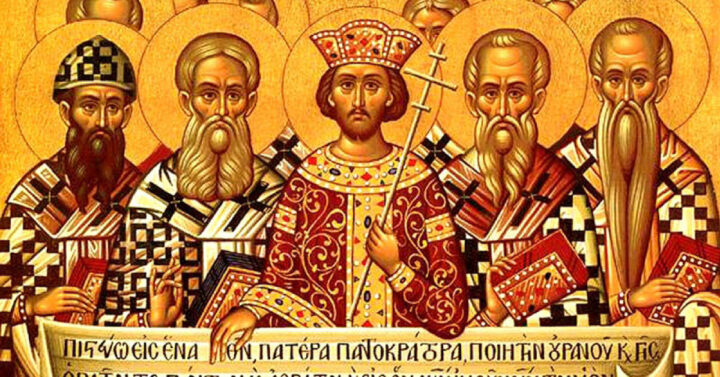
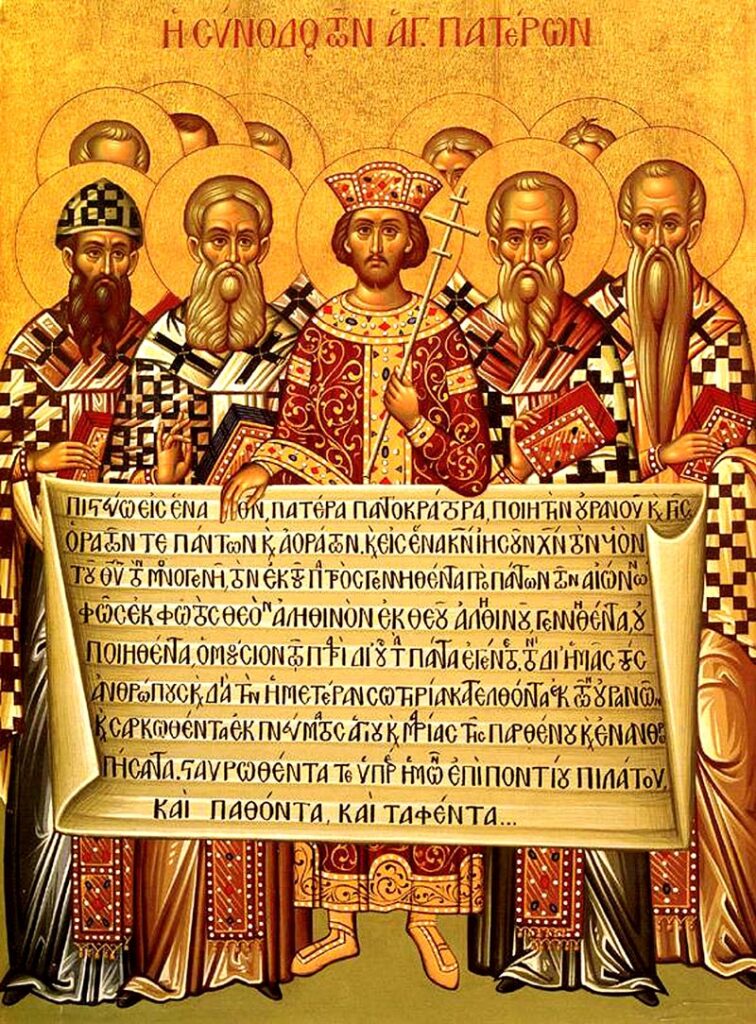
- First image: Symbolum Nicaeno-Constantinopolitanum. Icon depicting the First Council of Nicaea with ten men and a text of the Nicean Creed in Greek (public domain)
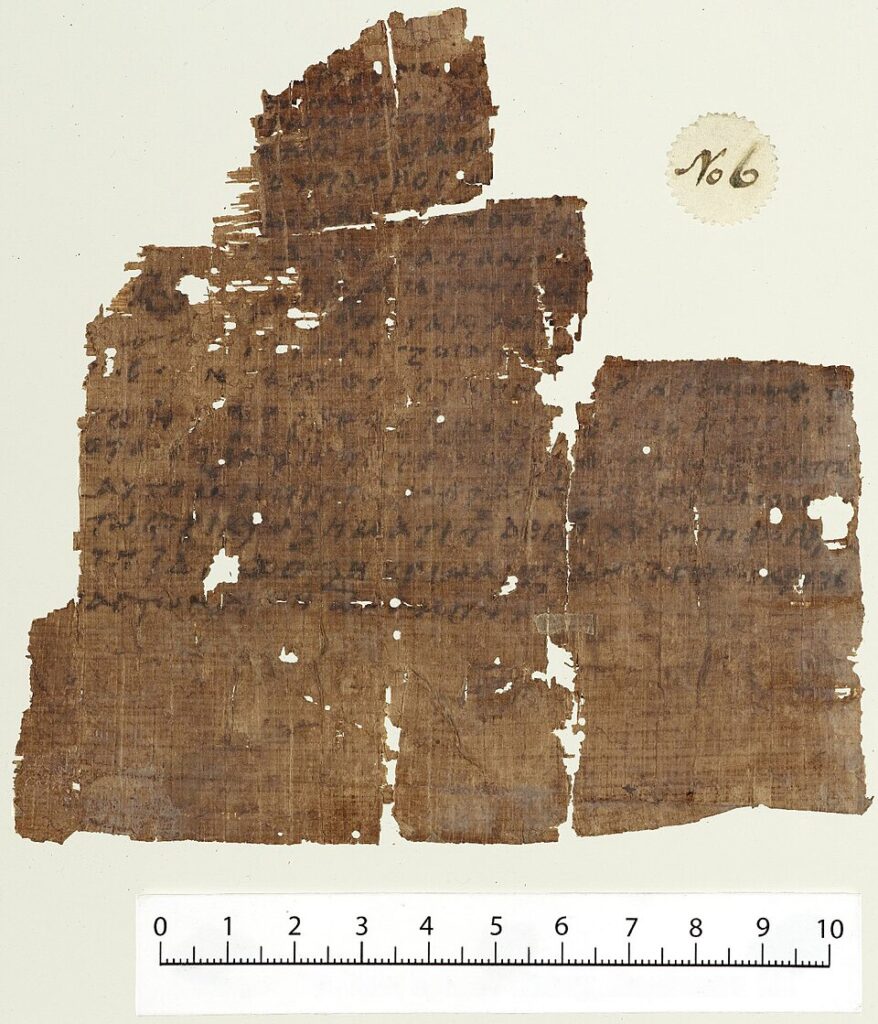
- Second image: Oldest extant manuscript of the Nicene Creed, dated to the 6th Century (public domain)

It’s definitely important to realize that salvation issues are the only real criteria for considering the label of “heresy”, and if the belief in who Christ is left intact, then it’s not an issue that require the heretic label.
And as much as the term “racism” has been overused to the point of being pointless, using “heresy” is in danger of being overused as well. It winds up having no meaning and is used as a manipulative emotional weapon rather than being a theologically thoughtful consideration for discussion.
I thought about the racism comparison as well. I left it out to keep that hot topic out of the post, but I agree. It’s largely become meaningless because it is so overused.
That’s one of my concerns about the heresy label. Someone is now a heretic in some circles because he promotes female Sunday School teachers. Or a deacon board decides someone is being “divisive” because they are asking questions about eschatology so they label him a heretic. His choices are shut up or leave under a cloud of shame due to the manipulative emotional weapons you mentioned.
It’s definitely important to realize that salvation issues are the only real criteria for considering the label of “heresy”, and if the belief in who Christ is left intact, then it’s not an issue that require the heretic label.
And as much as the term “racism” has been overused to the point of being pointless, using “heresy” is in danger of being overused as well. It winds up having no meaning and is used as a manipulative emotional weapon rather than being a theologically thoughtful consideration for discussion.
I thought about the racism comparison as well. I left it out to keep that hot topic out of the post, but I agree. It’s largely become meaningless because it is so overused.
That’s one of my concerns about the heresy label. Someone is now a heretic in some circles because he promotes female Sunday School teachers. Or a deacon board decides someone is being “divisive” because they are asking questions about eschatology so they label him a heretic. His choices are shut up or leave under a cloud of shame due to the manipulative emotional weapons you mentioned.
If you missed this post, it’s definitely relevant to this discussion.
Church Traditions and The Calf Path
https://sallieborrink.com/church-traditions-and-the-calf-path
If you missed this post, it’s definitely relevant to this discussion.
Church Traditions and The Calf Path
https://sallieborrink.com/church-traditions-and-the-calf-path/