








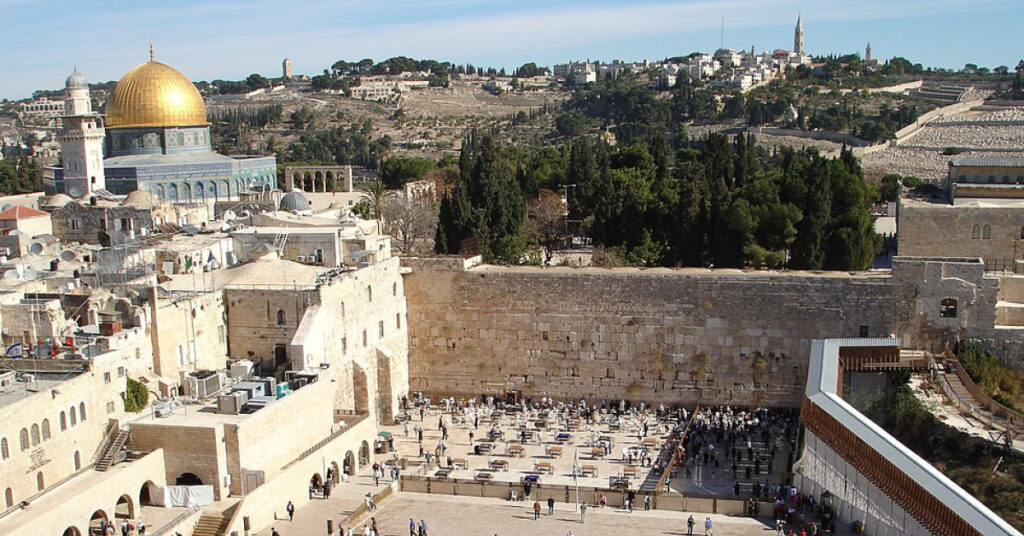
So when people go to the Wailing Wall, what are they visiting? It’s highly probable the wall has nothing to do with the Temple but is part of a Roman fortress. (Hat Tip to Vox Day for this post.)
Jesus made it clear that the Temple would be destroyed. In Matthew 24:1-2 (as well as Mark 13 and Luke 21), we read:
As Jesus left the temple and was walking away, His disciples came up to Him to point out its buildings.
“Do you see all these things?” He replied. “Truly I tell you, not one stone here will be left on another; every one will be thrown down.”
So was Jesus wrong?
From the article Holy Irony! we read:
We have two major problems here. First, Roman and Christian literary sources agree with Jesus that not one stone of the Temple was standing on another. How can we reconcile this with the fact that the walls of the alleged Temple Mount still have more than 10,000 stones standing upon another? Secondly, Josephus, an eyewitness, says that that the only major building that the Romans spared in 66-70 was their own imperial headquarter, the Roman fort called Fort Antonia, built by Herod the Great and named after his patron Mark Anthony. Where is this fort? Archaeologists have been digging for it in vain, and can’t even agree where it was located. Here is what Israeli archaeologist Shlomit Weksler-Bdolah has to say:
Surprisingly, despite the long duration of military presence in Jerusalem, … no archaeological remains have been attributed with certainty to the military camp and its site has not yet been identified. … One cannot underestimate the difficulty caused by the absence of irrefutable evidence of the Roman army camp in Jerusalem. … At this stage, there is no acceptable solution to the problem of the “lack of remains”.
Fort Antonia housed a legion, that would number at least 5000 men and about 5000 support personnel. Josephus tells us it was like a city in size, dominating the Jewish city. It was so large that troops could perform military maneuvers within the enclosure, in mock war training exercises. We know that Fort Antonia was not destroyed in 70 because it continued to house the Roman Legion X Fretensis until 289 AD, when the Legion was transferred to Ailat on the Red Sea.
So while the sources tell us that the Temple was demolished down to the bedrock and the Roman fort remained in use for 200 years, we are nevertheless asked to believe that the opposite happened: the huge fortified Roman fort disappeared entirely, while the Temple compound is still perfectly recognizable, with its four walls almost intact.
By some additional miracle, that alleged Temple compound, the Haram esh-Sharif on which now stand the Dome of the Rock and the Al-Aqsa Mosque, fits the standard design and size of the Roman forts scattered throughout the empire, and built after the pattern of the Praetorian Camp in the northeastern part of Rome.
There is only one way to make sense of this absurd situation: the Roman fort has been mistaken for the Temple Mount. As Professor George W. Buchanan put it in a 2011 article for the Washington Report for Middle East Affairs: “While it has not been widely published, it assuredly has been known for more than 40 years that the 45-acre, well-fortified place that has been mistakenly called the ‘Temple Mount’ was really the Roman fortress — the Antonia — that Herod built.”
So why is everyone keeping up the charade? Why do Christians, of all people, go to do everything short of literally worshiping a wall that has nothing to do with Jesus – temple or not? A wall that Jesus himself said would cease exist?


Because this is what Christian theologians and the Jewish state want us to believe. Kinda like that the Jews currently are still God’s chosen people or are Christians today?
These are some interesting observations, and I appreciate you noting them and bringing this up. Never actually knew some of this information. I love history and this is fascinating.
I finally started reading Josephus from the beginning, and learned that he was not only a Jew, but also a priest, and apparently a fairly devout one who did not support the revolt against the Romans.
I also am beginning to wonder why I’ve never heard of stones from the Temple itself being found, other than a sign from the courtyard and a trumpet rest or something like that from the outer wall. I think I read that the Wailing Wall had to be mostly or entirely cleared of rubble to expose the 60-foot wall we see today.