
I found some helpful perspectives about AI that parallel my own experience. At the end, I’ll share my strategic long-term choice that mirrors these thoughts by other creatives.
I’ve been experimenting with AI for about nine months. During that time, I’ve used it in a variety of ways.
How I’ve Used AI
David has used it for website troubleshooting. It has been enormously helpful with that. In the process, he has learned a lot. I think this is one of the best ways to use AI.
I tried writing a few posts with AI early on. They were okay, but I had to do so much revising of what it gave me that it really didn’t save me any time. After doing a few, I didn’t feel any draw to it for that reason. My voice is my own and I’d rather write my own words.
I’ve used it extensively for research, both personal and professional. Sometimes it helps me find a rather obscure answer quickly. Sometimes it helps me gain a surface understanding of a big topic rather quickly. I’ve shared some of that in posts where it is clearly identified as AI generated such as Reading The New Testament Books in the Order They Were Written.
As long as I keep in mind the limits of AI and fact check anything important, I think it can be helpful.
So overall, I find AI helpful for bouncing ideas around. But I don’t find it useful for writing. I tried that early on with a few posts just to try it. It doesn’t sound like me. And once you have used AI a fair amount, you can pick out AI writing right away. I can tell which YouTubers are basically reading AI generated copy now. They may be real people, but it’s not their own content.
The Temptation of AI
I wrote a few paragraphs on Telegram recently about AI. I said:
I have been working on a post for hours today. This is normal and fine because I am a writer. But I also just want to be done and hit publish! lol
Readers should recognize how tempting it is now for bloggers, writers, etc. to pop that partially finished text into AI and have it perfectly finished up in less than 15 seconds.
The same will hold true for homeschoolers dealing with their children learning to write. It’s so tempting to let them use a bit of AI here and there. Don’t do it. Make them do the hard thing and push through.
Doing the work yourself forces you to sort out your thoughts over and over again. Handing it off to an LLM deprives your brain of that important process.
Stay human as much as possible. Use AI sparingly when it can be truly helpful. But don’t let it become a crutch that makes you or your child less than you can truly be with the effort.
So that’s my experience with AI thus far. I’m not an AI evangelist. I find it creepy in some ways. But I also have not been afraid to use it and experiment with it.
So let’s get into where AI is headed.
Where Is AI Headed and What Is It Doing To Us?
First is a tweet from Jeremy Wayne Tate. This will be quoted in another quotation below so I’m sharing it first.
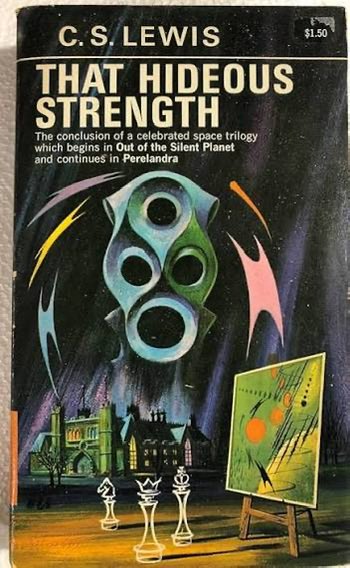
C.S. Lewis predicted AI in That Hideous Strength. N.I.C.E., that’s AI. Fans know what I’m talking about.
AI’s problem is not going to be its inability to do anything, but that it ruins everything. It creates a cultural problem. It sterilizes everything and makes nothing desirable.
The real danger isn’t incompetence; it’s efficiency without soul. Lewis imagined a world where technique replaced wisdom, where power outran virtue, and where the language of progress masked the erosion of meaning. AI can generate endless words, images, and music, but culture has never been about endless production. Culture is inheritance. It is formed slowly, through discipline, memory, imitation, and love of what is beautiful and true. When creation becomes instantaneous, the risk is not scarcity but saturation and a flood of content so frictionless that nothing feels earned, and therefore nothing feels worth longing for.
A world where you can make anything at any time can easily become a world where nothing feels necessary. That is the paradox Lewis hinted at…the more perfectly we manufacture expression the more we risk hollowing out the human longing that gives culture life in the first place. The task ahead is not to reject AI outright, but to resist letting it become N.I.C.E.
Someone named Neon Revolt wrote this when asked about how he’s using AI:
No, I don’t use AI when it comes to my written work. I’d be happy to admit if I was, like I do with my music, but I don’t see the value-add really when it comes to creative writing. It’s not that I don’t think AI is ever useful or capable, but… I enjoy the process of creative writing, and part of the joy comes from the specificity of the moment-to-moment beats you create, and arranging them into a coherent whole that synthesizes into something bigger and more ephemeral, which scrapes at the surface of deeper meaning, and hopefully roots itself in the heart and mind of the reader.
I have used AI, out of curiosity, for feedback on certain chapters long ago, but I didn’t find what it came up with particularly useful or actionable. Frankly, it tried to generate story ideas off-the-cuff, but they were all pretty cringeworthy and off-the-rails. I couldn’t use any of them, even if I wanted to, as they all just didn’t feel right. Maybe newer models are better, but I don’t feel particularly motivated to try them out. I could see myself using AI to replace hiring an editor, by which I mean in order to do a close inspection for a grammar and spelling pass-through, but that’s using it as a glorified spell-checker looking for technical mistakes, not dealing with story issues.
Part of what I’ve observed aligns with what Ben Affleck famously said, where AI “trends towards the mean.” It’s ingested all this “stuff” but it has never actually experienced emotions alongside it. Sure, it has knowledge of every great work ever written, but it can never truly feel them, and thus, it can’t intuit how to innovate new ways to achieve the same save by pure happenstance.
But I read a great comment today that summed up part of what I’ve been thinking and feeling when it comes to AI and creative writing:
(He inserted the above tweet here)
I’m generally a fan of AI where it can remove inefficiencies and bring down the cost of creation. Automation has always accomplished this. But “generation” is not the same as cultivation, and we run the risk of squandering a cultural inheritance through endless iterative imitations of former works.
I recently read a story of an author who specializes in Harlequin-romance style books, and was previously able to churn out about 10 or 12 a year. Harlequin, for those unfamiliar, is known for its structure, where all the “bodice rippers” generally follow the same or similar story beats. It could be the maiden getting swept off her feet by the pirate captain in one novel, then the dashing rogue in another. A werewolf in one, followed by a soldier in the next – but that’s kind of the point. The readers of Harlequin romance know what to expect within the genre. Well, this author decided to cook up her own AI, and now “she” is churning out 200+ books a year, all in this genre. And they’re selling, too, which is the crazy part, and now she doesn’t need to hit a thousands of copies sold of one particular book to make a living, but can sell 10 copies here, 5 copies there, and so on and so forth, until all her books have delivered to her a decent, automated five-figure annual sum in aggregate. And all she had to do was essentially play romance novel mad libs with her custom-trained AI, and poof, here is “her” book. And now, of course, she’s going to be licensing this tech to other authors with the promise of them being able to emulate what she’s created.
I think it’s okay if AI assisted or created works are sold alongside that of people doing it the old-fashioned way, but I also think the readers of that will still yearn for that human-connection that only comes from lived experiences and deep introspection – two things which AI is incapable of doing. I love it in the quote above where he says how frictionless work means the work feels unearned, and therefore unworthy of being yearned after. I think that’s largely true. Work must be cultivated, and even when I publish my music, I’m trying to take it that extra step. It could be me humming the song I had in my head for the computer to base an instrumental track on, and then editing the files manually, to get tracks to all align and be at the level I feel they need to be – and I suppose someone could make the argument that that harlequin author is just doing the same thing I’m doing with my music – but I think that’s a bit of a false equivalence because, just take my last album for example. All those songs are songs that have been preserved and have a heritage several hundred years old. I’m iterating on them, reinterpreting them, stewarding that heritage as an inheritance. I’m not sure I see the same level of effort by people just pressing “go” on their “idea generation machine.”
Which isn’t to say “It’s different when I do it,” but the ease of iteration does lead to the temptation to just streamline the publishing process. I’ve made 5 albums in two years, not 200 books in one year. There’s a scale, a gradient here.
All that to say, I won’t be using AI with this, not that I’m deeply against it, but because I don’t think it helps in this particular instance. I’ve been working off and on, on this particular novel for years, as time and other factors have allowed, and with any luck, I’ll be crossing the finish line with it this year, and it will be 100% human.
(Sidenote: We may see the emergence of a “seal of humanity” for creative works, in the future. Kind of like how organic produce has a particular label on it to be called organic that reflect a set of standards. I wouldn’t be surprised if that emerges in short order).
The part about the romance writers spoke to me as both a reader and a writer.
As a reader, I admire people who write well. I don’t want to read something spit out by a trained LLM. I want to read things written by a real person with a real heart and soul.
As a writer, I constantly go back to something a YouTuber said. He asked (and I’m paraphrasing) how you would feel if someone pointed out something you wrote and talked about how it made a big impact on his life but you realized it was written by the AI and not you.
If people want to use AI, then that’s their choice. But I would strongly prefer that it be labeled as such. Don’t show me the catalog of books you “wrote” when all they are is machine generated formula.
Which brings me to my last point.
Seal of Humanity
The very end sidenote especially interested me because I made a similar observation to David just a day or two ago when thinking about the long-term. Again, Neon Revolt said:
(Sidenote: We may see the emergence of a “seal of humanity” for creative works, in the future. Kind of like how organic produce has a particular label on it to be called organic that reflect a set of standards. I wouldn’t be surprised if that emerges in short order).
This is one of the reasons I decided to keep my website basically AI-free other than when I clearly am quoting it. The growing backlash against AI leads me to believe that there could be a kind of reversal in search engines and the like in the not-to-distant future.
What would that look like?
Content “certified” to be written by a real human will get priority ranking or people will be able to sort by “real” versus “AI” generated content. I think the desire is already there. We simply haven’t been given the tools to do it. Most people will choose content created by real people if given the choice.
So that’s one reason why I’ve made a point of saying in my sidebar biography that I’ve been writing here for 20+ years about real life. I may not be the best writer on the internet, but I am real with real life experiences. In the end, I think the real writers and creators win.
How? I don’t know yet.
But the current AI trajectory we’re on is neither desired nor sustainable.

Thought-provoking
https://x.com/i/status/2021256989876109403