
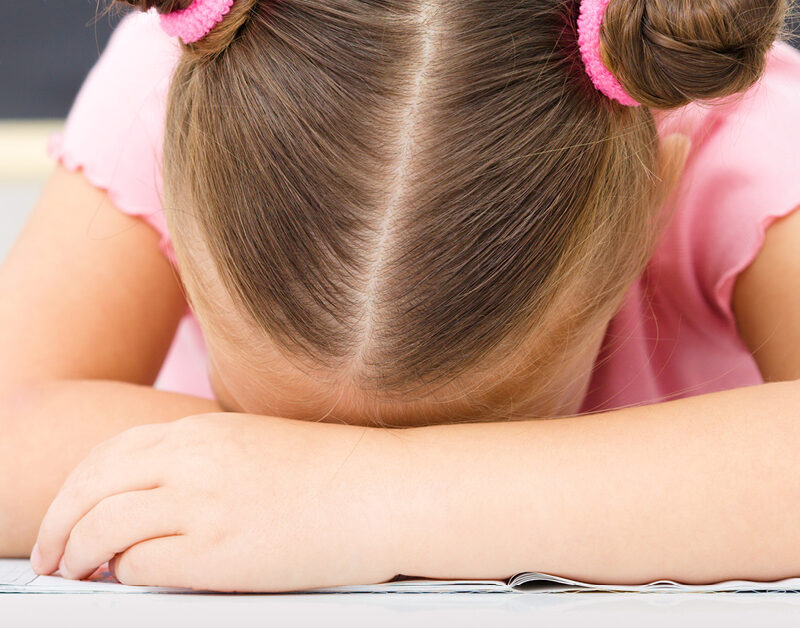
In a 2010 article from Psychology Today, Peter Gray, Ph.D., makes the case that math should not be taught until middle school. He shares a fascinating study from 1929 that has largely disappeared from the nation’s collective radar. But the findings are stunning regarding whether or not elementary students should study math.
In When Less Is More: The Case for Teaching Less Math in School he writes:
As part of the plan, he asked the teachers of the earlier grades to devote some of the time that they would normally spend on arithmetic to the new third R–recitation. By “recitation” he meant, “speaking the English language.” He did “not mean giving back, verbatim, the words of the teacher or the textbook.” The children would be asked to talk about topics that interested them–experiences they had had, movies they had seen, or anything that would lead to genuine, lively communication and discussion. This, he thought, would improve their abilities to reason and communicate logically. He also asked the teachers to give their pupils some practice in measuring and counting things, to assure that they would have some practical experience with numbers.
and
The results were remarkable. At the beginning of their sixth grade year, the children in the experimental classes, who had not been taught any arithmetic, performed much better than those in the traditional classes on story problems that could be solved by common sense and a general understanding of numbers and measurement. Of course, at the beginning of sixth grade, those in the experimental classes performed worse on the standard school arithmetic tests, where the problems were set up in the usual school manner and could be solved simply by applying the rote-learned algorithms. But by the end of sixth grade those in the experimental classes had completely caught up on this and were still way ahead of the others on story problems.
In sum, Benezet showed that kids who received just one year of arithmetic, in sixth grade, performed at least as well on standard calculations and much better on story problems than kids who had received several years of arithmetic training. This was all the more remarkable because of the fact that those who received just one year of training were from the poorest neighborhoods–the neighborhoods that had previously produced the poorest test results.
I found this article especially fascinating as I have an almost seven year old daughter who already dislikes math. By math I mean formal math. She has no problem making elaborate constructions with Tinker Toys or figuring out how to evenly divide the cookies. She will decide to measure things on her own. She will clean your clock in Uno. She effectively uses practical math when it makes sense in her world. But like many right brained children, formal math (especially memorization) is not her cup of tea.
I have mostly backed off from math up until this point. We do bits of things, but not a lot. This year I was going to try doing more math (since I’m feeling guilty), but I’m already seeing this is not going to be the year either. I bought the first book of Life of Fred to use this year after reading so many glowing reviews.
She hated it. (Anyone need to buy a copy?) She said she would much rather do the worksheets we were doing last year.
I continue to feel the unschooler in me begging to be given free reign. Somehow I can’t get past my personal hangup that it is just irresponsible to home educate that way even though I know that isn’t true. I observe many unschoolers doing spectacular things and admire how they educate their children. I’m just not able to personally make that final leap (yet). But as I work that out for myself, one thing is certain.
I’ve slowly come to the conclusion that much of what children are asked to do in the elementary years is busy work (often developmentally inappropriate) designed to keep them occupied until they are far enough along the conveyor belt to really begin their formal learning.
Edited: This article is referred to below in the comments: Formal Arithmetic at Age Ten, Hurried or Delayed?


 An Interview With Children’s Author, Monica Wellington
I agree that so much of early math is busy work that isn’t developmentally appropriate. We don’t unschool, but I plan activities that are hands-on and/or stimulating – all while being developmentally appropriate. He loves math because most of it seems like game time or plain old fun to him! :o)
I love this! My daughter (7) does not like math either! I also lean more toward unschooling however we are not there yet? I do not know if I ever will be there but we do have a very laid back style,I find myself sometimes falling into the busy work mode which makes me feel lazy 🙁 Great article!
This is so interesting! It actually reminds me a lot of the Bluedorns (who are definitely not unschoolers), who suggest waiting until 10 to introduce mathematics. Their suggestions are based on an understanding of the maturation of the brain. I’ve read the paper their opinion is (mostly) based upon, and it basically says that the part of the brain that is responsible for math isn’t fully myelinated until age 10 in the average child. That struck me when I first read it because I remember thinking that I was “bad at math” as a young child. I could do what my teachers asked me to do, but I knew I didn’t really understand it. Then around age 10 (fourth grade), it all clicked, and I adored math from then on. I even took math on purpose in college. 🙂
I personally don’t do “no” math (which is technically illegal in CA anyhow), but I only do what the child is capable of, which means that my third grader is just now doing “first grade” math, and my 11yo, though on “grade level” now, was a complete year “behind” at one point. I really think math is so much more tied to brain development than we tend to think, and there is so much shame involved in being “behind”–to the point where we are probably labeling children with immature brains as having learning disabilities!
Math is still very much a work in progress for us, and it was this study (among other things) that helped me relax about my 10-year-old’s current skill set. My daughter most definitely learns at her own pace and in her own way, and math is a prime example. Two years in a charter program showed me just why no amount of drilling, workbooks, math blocks, or even games would give her much more than a disdain for math. Now, a year after withdrawing, she’s finally doing what I feared she never would–seeking out opportunities to learn sums and money. I wish now we hadn’t gone through all that stress.
Sallie, I could’ve written this post. Wow. My daughter, also 7, also dislikes math and I struggle with myself over whether or not to push the issue or let it go. She also dislikes Life of Fred, although her right-brained brothers both like it.
I’ve mostly let it go. She will do things in bursts, like teaching herself to count to 100, then to 1000, by focusing on it exclusively until she masters it. But give her an addition equation, or goodness help me, pull out the dreaded workbook, and she is outta here.
Ironically, I found your post while researching a post I’m writing about hands-on math.
Off to follow you on the various social networks now. Glad to find your blog. 🙂
Love this. My almost 7yo (girl) loves math and does it for fun, but my 9 yo (boy) hates it unless it’s for a purpose — Yahtzee, or figuring out his batting average. We have much better school days with less tears and frustration since I gave up on doing daily math. (We’ve also switched to Beast Academy, which is much more fun than regular math curricula. Not like he loves it, though, since it’s still math.)
Really interesting info, Sallie. My daughter (7) also dislikes math. Well, not all math. She really gets anything related to geometry, patterns, fractions, etc. But we are struggling with the basic math facts. I’m trying to decide what to do next year because what we’ve done this year has definitely not been going great.
Hi Esther!
What kind of learner is your daughter? I ask because some kinds of learners do not memorize well, especially math facts.