Introduction
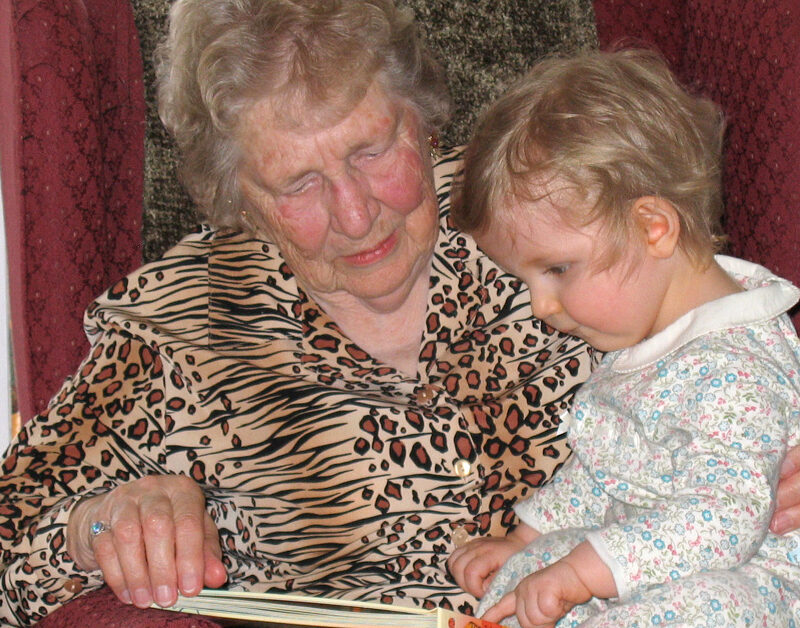
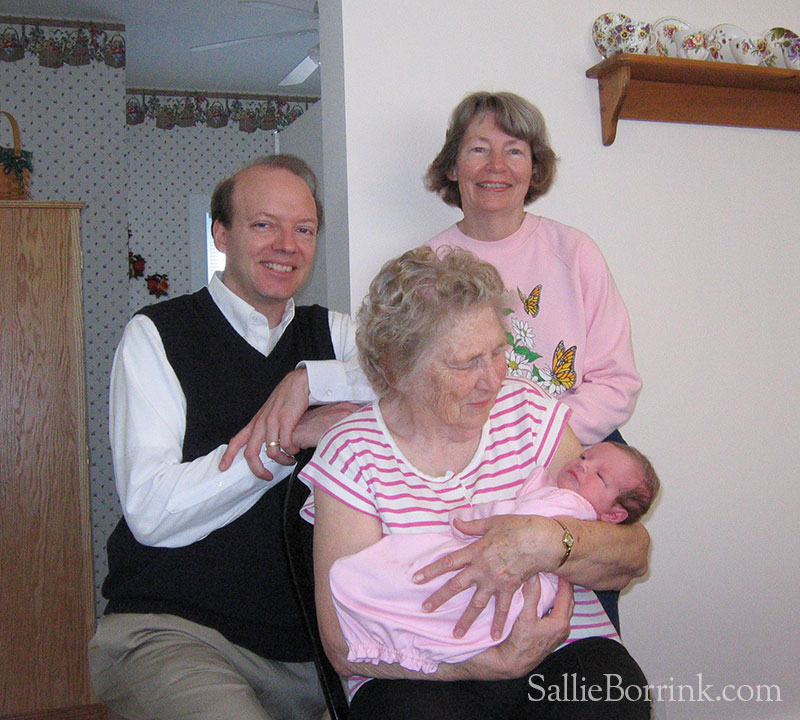
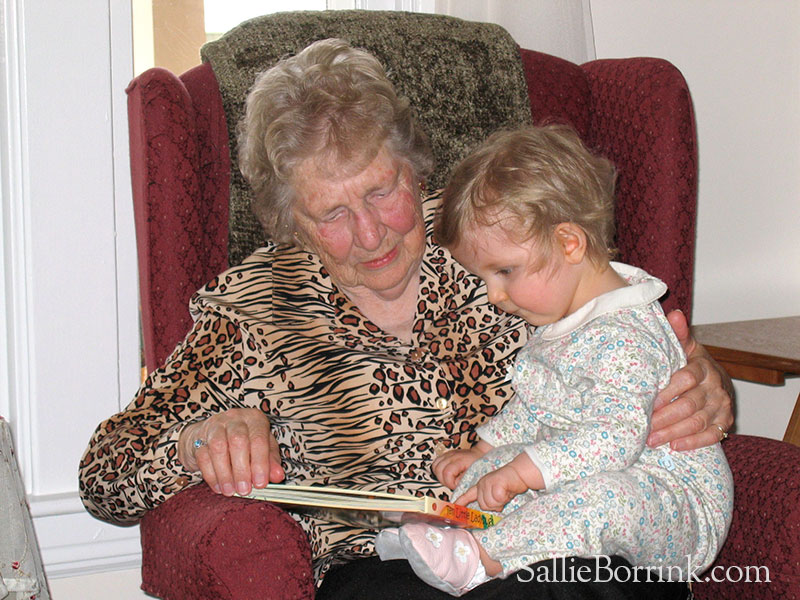
As part of my Michigan Unit Study resources, I am sharing this true family remembrance as an example of a “living book” for homeschoolers and as a genealogical record for researchers. Johanna (Bruin) Baareman is my husband’s maternal grandmother. She was the last surviving of our grandparents and the only one to meet Caroline, our daughter. I hope this account brings Michigan history to life, showing what it was like for Dutch immigrants and their descendants in our state.
Below you will find photographs and the full text of family memories. Names are bolded for clarity and genealogical search. Section titles have been added by me to make it easier to read and for search purposes. Otherwise, the original text has not been edited or altered. Permission to publish this here was given by Johanna’s daughter, JoAnn.
Family Photos
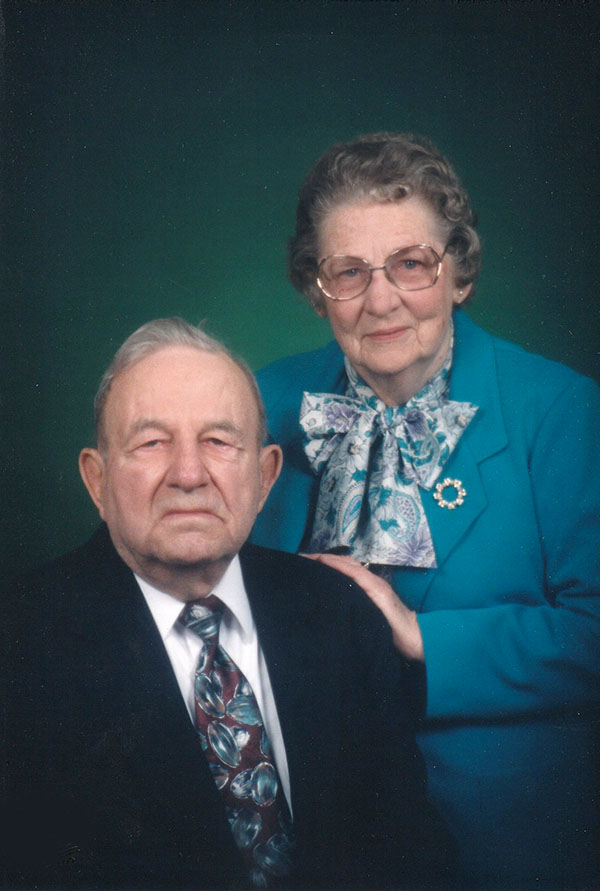
Early Life in the Netherlands
As told to her great-nephew Ken Stebbins, on November 26, 1999
My great aunt Jo is the youngest sister of my maternal grandmother Hilda (Bruin) Postma. Jo was born on April 4, 1917. I was born on her birthday, 41 years later in 1958. We always had fun sharing this birthday bond. Much of the information in this paper was told to me by Aunt Jo during a quiet afternoon at the home of my Mother, Jayne Stebbins, with Jo’s husband, my great uncle Nate. They both seemed to enjoy sharing their memories of childhood and young adulthood. The centerpiece of our discussion was the picture albums that she and her mother Janna (Bos) Bruin had put together in the 1920s, 30s, and 40s.
The earliest memories were stories her mother Janna told of her childhood in the Netherlands. In general, Janna and her husband Willem (William) Bruin did not speak much about their life in the Netherlands before they came to America in 1902. Janna Bos was born in the Netherlands on June 16, 1881, and died in Hudsonville, Michigan, USA, on January 4, 1974, at the age of 92 years, 6 months and 19 days.
According to my grandmother Hilda, Janna at age 5 had to work at a large dairy farm, washing milk dishes. Jo recalled Janna saying that the dairies of this time sent the best milk, butter and cheese to England, and the lower quality food was kept for the Dutch.
Another example of the hardships of life in the Netherlands was taxation burdens by the Dutch royalty. Jo showed me a picture of a Dutch house that was probably Janna’s home. Each window, door, and chimney was counted as a taxable item, and any minor home improvements were penalized by more taxes. It was also a crime in the Netherlands for the common citizens to kill wild game in the fields for food. Pheasants and other animals were only allowed to be hunted by the royal family.
Other more pleasant memories were recalled based on a photograph that Janna’s grandson Jack Kelder has, of the church where Janna was baptized; and a photograph that Jo’s daughter Jo Ann has, of a windmill that Janna would walk past every day on her way to school.
As a teenager, Janna would sing in cafes along the frozen canals where ice skaters would pass by. The singing was passed on to her daughters Henrietta, Hilda, Harmina, and Johanna who sang as a quartet in churches and homes in Michigan when they were young.
Immigration to America: The Journey from the Netherlands to Chicago
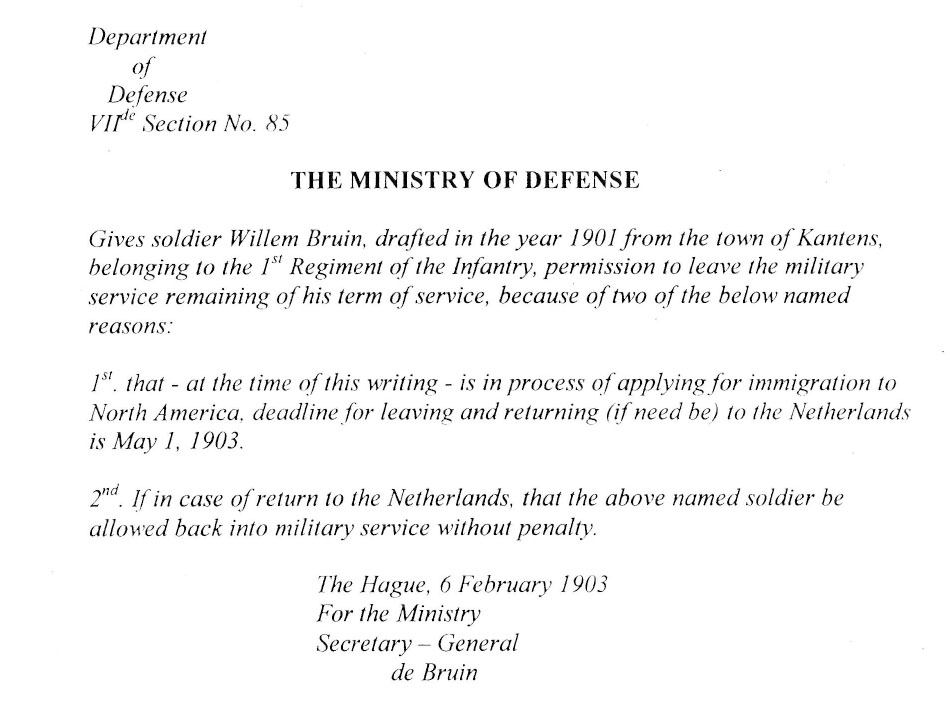
Janna’s husband was Willem (William) Bruin, born in the Province of Groningen, the Netherlands, September 12, 1881, and died of tuberculosis in Grandville, Michigan, October 26, 1941, at the age of 60 years, 1 month and 14 days. As a young man he was in the 1st Infantry Regiment of the Dutch Army, joining in 1901. He was given a temporary discharge from the Army when he came to the United States. Needless to say, he never returned. The following is a literal translation of the original Dutch military discharge paper.
William and Janna were married on April 11, 1902, and left the Netherlands three days later to immigrate to the United States. It is hard to imagine the emotions Janna and William faced as they left their families and home, never to see most of them again.
Janna said the reason they came to America was to have a better life for their children than the life they knew in the Netherlands. They boarded a steamship for New York City, a rough 5-week ocean voyage. William’s brother Riek (Fred) Bruin and his wife Clausen (Clara) Bruin accompanied them. They were in the steerage part of the ship, the lower deck for the cheapest fares. Seasickness was with them the entire trip. What a relief it must have been to set foot on Ellis Island, New York Harbor and not be seasick anymore. Any joy must have been short-lived however.
They had in their possession a trunk containing their best valuables and family belongings that was stolen on their arrival to New York City. Any mementos that we now possess from their days in the Netherlands were probably in their pockets or smaller baggage.
Their destination after arriving in New York City was Chicago. They took a train with brother Fred and Clara. They purchased a banana on the train, a fruit they had never seen, but threw it away because William did not know it had to be peeled before eaten. They refused to try another new food, tomatoes, because they thought they were poisonous. The train stopped at Niagara Falls, and although they were encouraged to get out and see the site, William and Janna did not dare leave the train, because they could not speak English.
When they arrived in Chicago, they were planning on changing their last name to the American equivalent, Brown. Friends advised them that there already were too many Browns in Chicago, so they kept their original name Bruin.
Life in Chicago
Their first child, a daughter named Henrietta, was born in Chicago. She died at the age of 22 months of diphtheria. She is buried at the Roseland Park Church in Chicago. A tin plate with the words “Our Darling” inscribed, was from little Henrietta’s funeral. Ken Stebbins has this plate. The wooden rocking chair from Chicago that Janna would use to rock Henrietta to sleep now belongs to Jayne Stebbins.
After Henrietta’s death, three more children were born in Chicago. Their second daughter was also named Henrietta Bruin (born April 7, 1905; died November 26, 1986). Then John Bruin was born on August 26, 1907 (died January 6, 1991), and Hilda Mae Bruin was born on January 28, 1910 (died April 16, 1984).
William and Janna had a Great Dane dog while living in Chicago, named Nellie. The dog would lay across the floor by the front door of their house. Janna trusted the dog to guard the house and children while William worked. In 1910, William decided to move to Grand Rapids, Michigan. He made a deal with a man to purchase a boat ticket for the Great Dane, along with his family for passage up Lake Michigan. The man stole the Great Dane, and William’s money for the passage. After this loss, William said that would be the end of speaking only the Dutch language.
Moving to Grand Rapids and East Grand Rapids
The family and all of their belongings made the boat trip up Lake Michigan to Grand Haven, and then up the Grand River all the way to Grand Rapids. They settled in East Grand Rapids for 12 years. Four more children, Dick Bruin (born May 9, 1911), Harmina Bruin (born August 15, 1912), Frederick William (Fritz) Bruin (born November 20, 1914, died May 13, 1991), and Johanna Bruin (born April 4, 1917) were born in East Grand Rapids. Another daughter was born after Johanna, but she only lived ½ hour. They first lived on the north side of Reeds Lake, where Dick and Harmina were born. Then they moved to the south side of Reeds Lake, (address: 2550 Lake Drive), where Fritz and Johanna were born.
William’s brother Fred and wife Clara, and their four sons (Derk Bruin, Hilbrand Bruin, Harm Bruin, Clarence Bruin) lived across the street on Lake Drive. William was a farmer in East Grand Rapids, and worked part time at a coal yard. They had two cows, Daisy and Maud, and a horse named Dolly. William made extra money peddling vegetables in Grand Rapids. Uncle Fred worked as a furniture maker.
East Grand Rapids was an affluent community. My Grandma Hilda told me they had the poorest house in East Grand Rapids. The children had the benefit of good schools.
Reed’s Lake was close to home, for lots of swimming during the summer. Hilda also remembered a special Christmas when she was 10 years old in 1920. That was the year the family got electricity in their house. They ordered a package of Christmas ornaments, parcel post from Sears in Chicago. The package had several angels, and cords of glass ornaments that still adorn some of our Christmas trees 80 years later. Before electricity, Grandma Hilda remembered Christmas trees with candles in their home. The candles were only lit for a few minutes on Christmas Eve, and buckets of sand or water were ready in case of the tree catching on fire.
Settling in Grandville, Michigan
In 1922, the Bruin family moved to Grandville, Michigan, on Prairie Street. William got a job working for the Pere Marquette railroad.
After moving to Grandville, Janna got a job working in the posh hotels of Petoskey and Harbor Springs, Michigan. Each summer she would leave the family and take the train north to find relief from asthma in the pollen-free air of northern Michigan. Since William worked for the railroad, Janna was able to use a rail pass for the trip north early in the summer. Then the family would drive up to get her in the fall, but only after the first hard frost had killed the ragweed and other pollens down in Grandville.
Summer Work Up North: Petoskey & Harbor Springs
Her first three years of going north were spent working at a hotel in Bay View. The rest of the years she worked as a chambermaid at The Club House in Harbor Springs, an exclusive, gated hotel for the wealthy. Janna would clean their rooms, and get to know many of the wealthy ladies. She recalled that people just on the fringe of being rich were full of worry that their good fortune could end. It was only the very rich that seemed unconcerned about losing their wealth. No cars were allowed on the grounds of the hotel.
The Harbor Springs railroad station was a site of wondrous recoveries for allergy sufferers. Janna told of seeing asthma patients from Chicago arriving by train on hospital beds, unable to rise. By the next day, the same people were walking the streets, enjoying a day of shopping.
When Janna’s daughter, Johanna, finished school, she also worked at The Club House with her Mother for three years, doing kitchen work and washing dishes. She had the chance to ride on beautiful yachts sailing the Little Traverse Bay during those summer days. Janna’s daughters would take adventurous trips by car to visit their Ma during the summer. It would take all day to drive from Grandville to Harbor Springs on the dirt and mud roads. They took many coffee breaks along the way. Johanna recalls her older sisters having the role of substitute Mother during the long summers while her real Mom worked up north.
Family Life, Health, and Work
While living in Grandville, William contracted tuberculosis of the lungs. He eventually lost the ability to work, and spent some time at the Sunshine Sanitarium, a hospital for TB patients. My Grandma Hilda told me that the children were scared of getting tuberculosis themselves. A doctor told the Bruin girls to gain weight as a precaution against getting the disease.
Hilda shared with me her feelings about the value of good health. She and her siblings saw the tragedy of their Pa (William) losing his health to tuberculosis. She never did anything that would harm her health, like smoking or drinking alcohol, because of her appreciation of the blessings of health that God gave her. Hilda had a severe case of diphtheria when she was about 2 years old while living in Chicago. She was unable to speak for the next year and a half because her throat was so injured by the disease. The first word she was able to say after the long silence was ‘cat’. Her father William loved cats, and that love has passed down five generations to my girls Elizabeth and Amelia. Grandma Hilda also enjoyed telling about a teacher in East Grand Rapids, who said that coffee would stunt the growth of children. Hilda loved to go to neighbor ladies’ houses with her Ma, Janna, and drink coffee with them. She sat in that schoolroom with a silent smile on her face, knowing that she was the biggest child in the class.
The Bruin children got jobs when they finished school to help the family get by financially. My Grandma Hilda graduated from 8th grade in Grandville in 1924. Right after graduation, at the age of 14, she got a job at the Keeler Brass factory. Hilda had to lie about her age, and say that she was 16 to get the job. Since she was tall for her age, no one questioned her, and she worked there for 8 years. Her sister Henrietta worked at another factory nearby. Most of their wages went to their Ma and Pa.
My Grandfather, Edward Postma, was the foreman of the women’s department at Keeler Brass. He met Hilda as her boss at the factory, and they married in 1932, during the depths of the Great Depression. As was the custom for married women at that time, the Bruin girls were stay-at-home wives and moms. They and their brothers all lived in the Grand Rapids area after getting married. Visits to William and Janna’s house in Grandville were common.
Family Reflections and Legacy
They would spend most Sundays with William and Janna as William’s health declined. My mother, Jayne (Postma) Stebbins, was their first grandchild, born on May 15, 1933 in Grand Rapids on Denwood Avenue. She loved visiting her Grandpa and Grandma Bruin, and recalls with sadness that she was never allowed to kiss Grandpa William because of the tuberculosis. He died of the disease in 1941 at the age of 60. My Grandma Hilda missed him greatly for the rest of her life. She spoke only loving memories of both of her parents.
The legacy of an immigrant family from the Netherlands, with God and a loving, caring family at the center of their lives, is indeed a rich heritage for the generations to come.
Want More Living Book Family Histories?
This remembrance is the first part of my Family Histories Collection that I will be adding to. If you’d like more stories like this for your homeschool and other practical unit study ideas for Michigan, I hope you will subscribe.
Feel free to make a printable PDF copy of this story for your family’s homeschool binder or your personal genealogy files. Permission in NOT granted to copy, upload, and/or share this content anywhere else.
If you have a Michigan family story you’d like to share here, please contact me!

 Free United States Map Printable for Homeschoolers
I know I’ve met a few of my grandmother’s siblings, and also remember seeing great-grandma Janna before she passed away in the early 70’s. We had this tradition of a family reunion at Great Aunt Hilda’s farm near North Dorr on Memorial Day for a number of years when I was a child, and always remember playing with my immediate cousins and distant cousins all related to these people. So many good memories of great cookouts, playing tag in the barn in the hay bale area, going off to a nearby woods, and great weather every year, I think.
It seems to be a somewhat common story to hear of one’s ancestors arriving in America and being taken advantage of. But by the grace of God, our ancestors made their way here in their day-to-day lives, and faithfully raised their families, and eventually it leads to us.