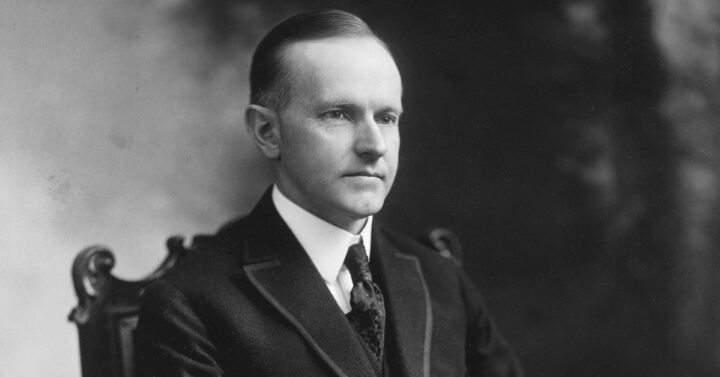
This article appeared in the February 1921 issue of Good Housekeeping. Calvin Coolidge was to be inaugurated as Vice President the following month. Over 100 years have passed and we are back to the point of needing to ask the same questions and make the same points in order to protect our country. At the end of the post, you can download the entire article in the original layout in PDF format. I used AI to scan and transcribe the original article and made every effort to provide a complete and accurate transcript.

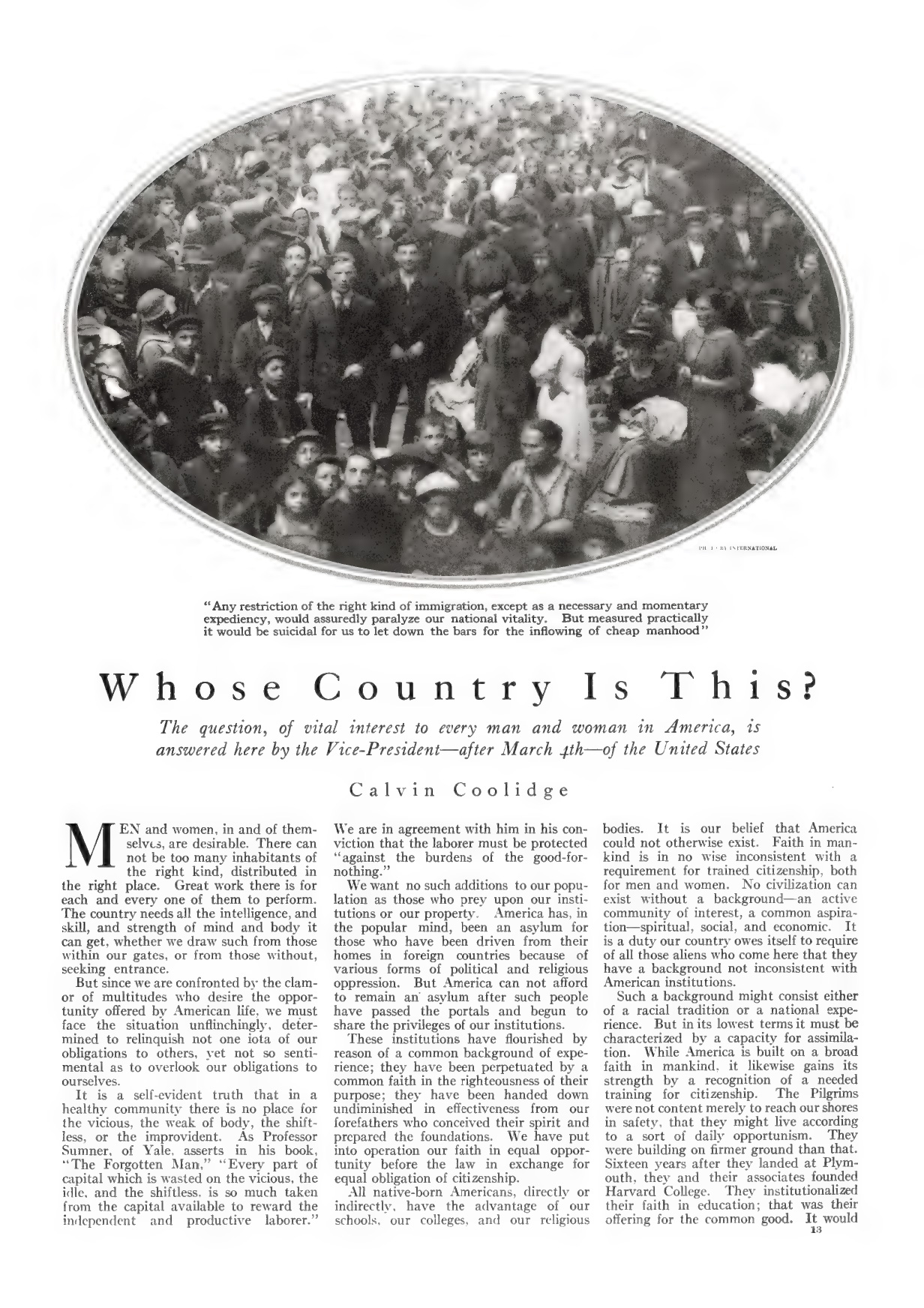
“Any restriction of the right kind of immigration, except as a necessary and momentary expediency, would assuredly paralyze our national vitality. But measured practically it would be suicidal for us to let down the bars for the inflowing of cheap manhood.”
Whose Country Is This?
The question, of vital interest to every man and woman in America, is answered here by the Vice-President — after March 4th — of the United States
By Calvin Coolidge
Men and women, in and of themselves, are desirable. There can not be too many inhabitants of the right kind, distributed in the right place. Great work there is for each and every one of them to perform. The country needs all the intelligence, and skill, and strength of mind and body it can get, whether we draw such from those within our gates, or from those without, seeking entrance.
But since we are confronted by the clamor of multitudes who desire the opportunity offered by American life, we must face the situation unflinchingly, determined to relinquish not one iota of our obligations to others, yet not so sentimental as to overlook our obligations to ourselves.
It is a self-evident truth that in a healthy community there is no place for the vicious, the weak of body, the shiftless, or the improvident. As Professor Sumner, of Yale, asserts in his book, “The Forgotten Man,” “Every part of capital which is wasted on the vicious, the idle, and the shiftless, is so much taken from the capital available to reward the independent and productive laborer.” We are in agreement with him in his conviction that the laborer must be protected “against the burdens of the good-for-nothing.”
We want no such additions to our population as those who prey upon our institutions or our property. America has, in the popular mind, been an asylum for those who have been driven from their homes in foreign countries because of various forms of political and religious oppression. But America can not afford to remain an asylum after such people have passed the portals and begun to share the privileges of our institutions.
These institutions have flourished by reason of a common background of experience; they have been perpetuated by a common faith in the righteousness of their purpose; they have been handed down undiminished in effectiveness from our forefathers who conceived their spirit and prepared the foundations. We have put into operation our faith in equal opportunity before the law in exchange for equal obligation of citizenship.
All native-born Americans, directly or indirectly, have the advantage of our schools, our colleges, and our religious bodies. It is our belief that America could not otherwise exist. Faith in mankind is in no wise inconsistent with a requirement for trained citizenship, both for men and women. No civilization can exist without a background — an active community of interest, a common aspiration — spiritual, social, and economic. It is a duty our country owes itself to require of all those aliens who come here that they have a background not inconsistent with American institutions.
Such a background might consist either of a racial tradition or a national experience. But in its lowest terms it must be characterized by a capacity for assimilation. While America is built on a broad faith in mankind, it likewise gains its strength by a recognition of a needed training for citizenship. The Pilgrims were not content merely to reach our shores in safety, that they might live according to a sort of daily opportunism. They were building on firmer ground than that. Sixteen years after they landed at Plymouth, they and their associates founded Harvard College. They institutionalized their faith in education; that was their offering for the common good. It would not be unjust to ask of every alien: What will you contribute to the common good, once you are admitted through the gates of liberty? Our history is full of answers of which we might be justly proud. But of late, the answers have not been so readily or so eloquently given. Our country must cease to be regarded as a dumping ground. Which does not mean that it must deny the value of rich accretions drawn from the right kind of immigration.
Any such restriction, except as a necessary and momentary expediency, would assuredly paralyze our national vitality. But measured practically, it would be suicidal for us to let down the bars for the inflowing of cheap manhood. just as, commercially, it would be unsound for this country to allow her markets to be overflooded with cheap goods, the product of a cheap labor. There is no room either for the cheap man or the cheap goods.
On every hand we hear that the quality of immigration is not what it used to be. This is unwisely construed as meaning that we must withdraw our faith in mankind and raise rigid barriers always. Such a confession would declare the weakness of our institutions and undermine our faith in the principles on which the government is founded. The continuance of our faith is not interrupted by our intense conviction that there is no room in our midst for those whose direct purpose is political, social, or economic mischief, and whose presence jeopardizes the physical or moral health of the community.
Certain laws of supply and demand take care, in normal times, of the coming and going of the alien. But it may be that today conditions abroad are so intolerable that men and women run chances in conditions they must face. Wise immigration laws would deal with such a pressure. Generally, and under normal conditions, people turn to America when there is something that attracts them, when they can find here an opportunity. If such an opportunity no longer exists, they do not come. Should this country experience a period of economic depression, the natural working of this law would be that many classes of unskilled labor—especially those who come here temporarily, expecting to return once they have accumulated sufficient money—would, of their own accord, leave the country.
It must always be borne in mind that each and every individual is not only a producer but a consumer. In the final analysis of our conditions, we have to admit that it is not lack of consumption, but lack of production which is our present economic danger. The immigrant is needed, provided this fact is overcome, provided supply—whether in schools, in homes, or in shoes—does not fall behind demand. The public could today consume much more of the necessities of food, shelter and clothing than they are able to procure or have ever been able to procure in a country where the standard of living is so high. If, through cheap labor, and an increased willingness on the part of alien labor to live on the edge of existence, these standards are threatened, then the time to bring legislative action to bear on the situation.
The laws of supply and demand, therefore, are adjuncts to immigration regulation. I do not fear the arrival of as many immigrants a year as shipping conditions or passport requirements can handle, provided they are of good character. But there is no room for the alien who turns toward America with the avowed intention of opposing government, with a set desire to teach destruction of government—which means not only enmity toward organized society, but toward every form of religion and so basic an institution as the home.
If we believe, as we do, in our political theory that the people are the guardians of government, we should not subject our government to the bitterness and hatred of those who have not been born of our tradition and are not willing to yield an increase to the strength inherent in our institutions. American liberty is dependent on quality in citizenship. Our obligation is to maintain that citizenship at its best. We must have nothing to do with those who would undermine it. The retroactive immigrant is a danger in our midst. His discontent gives him no time to seize a healthy opportunity to improve himself. His purpose is to tear down. There is no room for him here. He needs to be deported, not as a substitute for, but as a part of his punishment.
We might avoid this danger were we insistent that the immigrant, before he leaves foreign soil, is temperamentally keyed for our national background. There are racial considerations too grave to be brushed aside for any sentimental reasons. Biological laws tell us that certain divergent people will not mix or blend. The Nordics propagate themselves successfully. With other races, the outcome shows deterioration on both sides. Quality of mind and body suggests that observance of ethnic law is as great a necessity to a nation as immigration law.
From its very beginning our country has been enriched by a complete blend of varied strains in the same ethnic family. We are, in some sense, an immigrant nation, molded in the fires of a common experience. That common experience is our history. And it is that common experience we must hand down to our children, even as the fundamental principles of Americanism, based on righteousness, were handed down to us, in perpetuity, by the founders of our government.
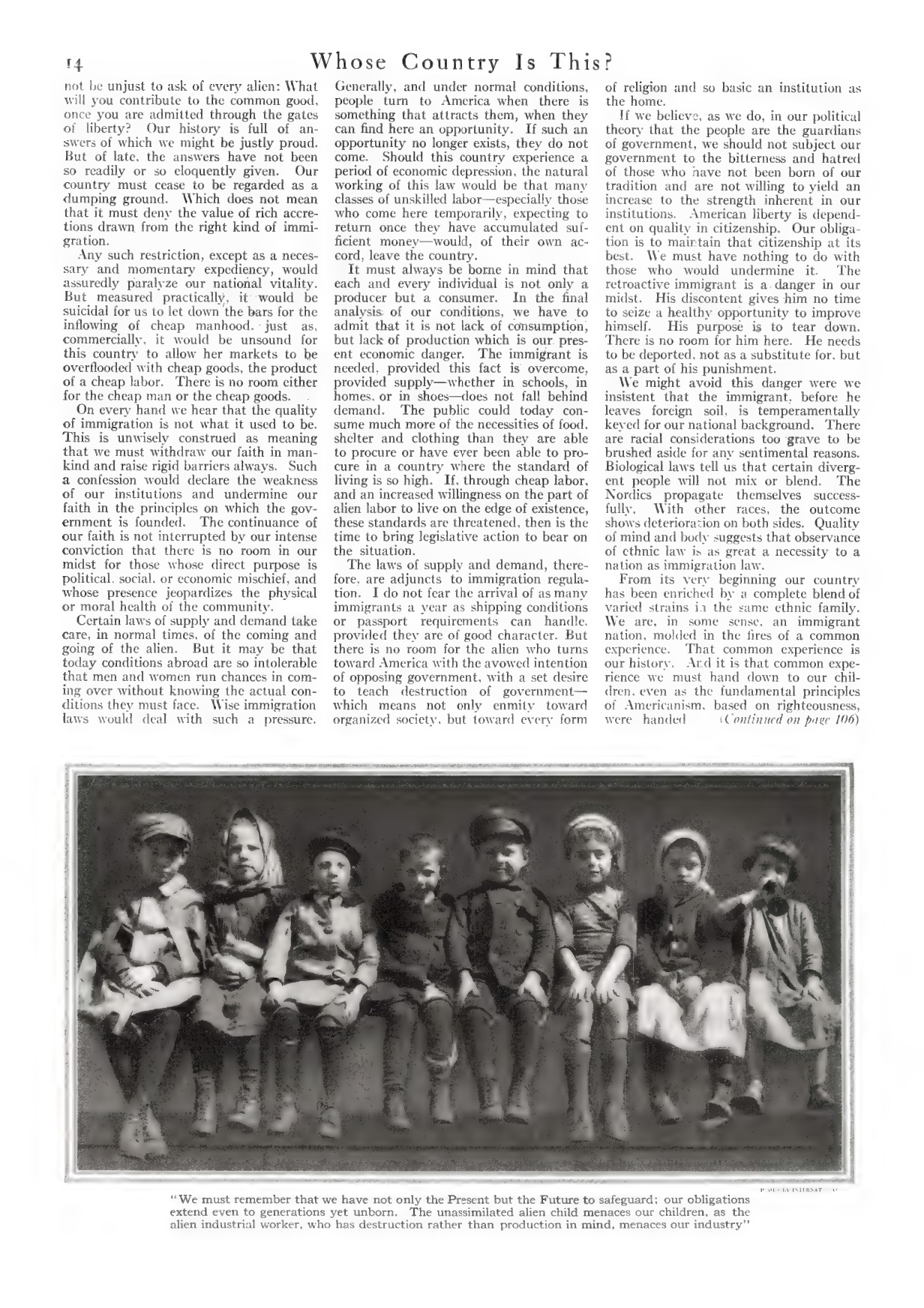
“We must remember that we have not only the Present but the Future to safeguard; our obligations extend even to generations yet unborn. The unassimilated alien child menaces our children, as the alien industrial worker, who has destruction rather than production in mind, menaces our industry.”
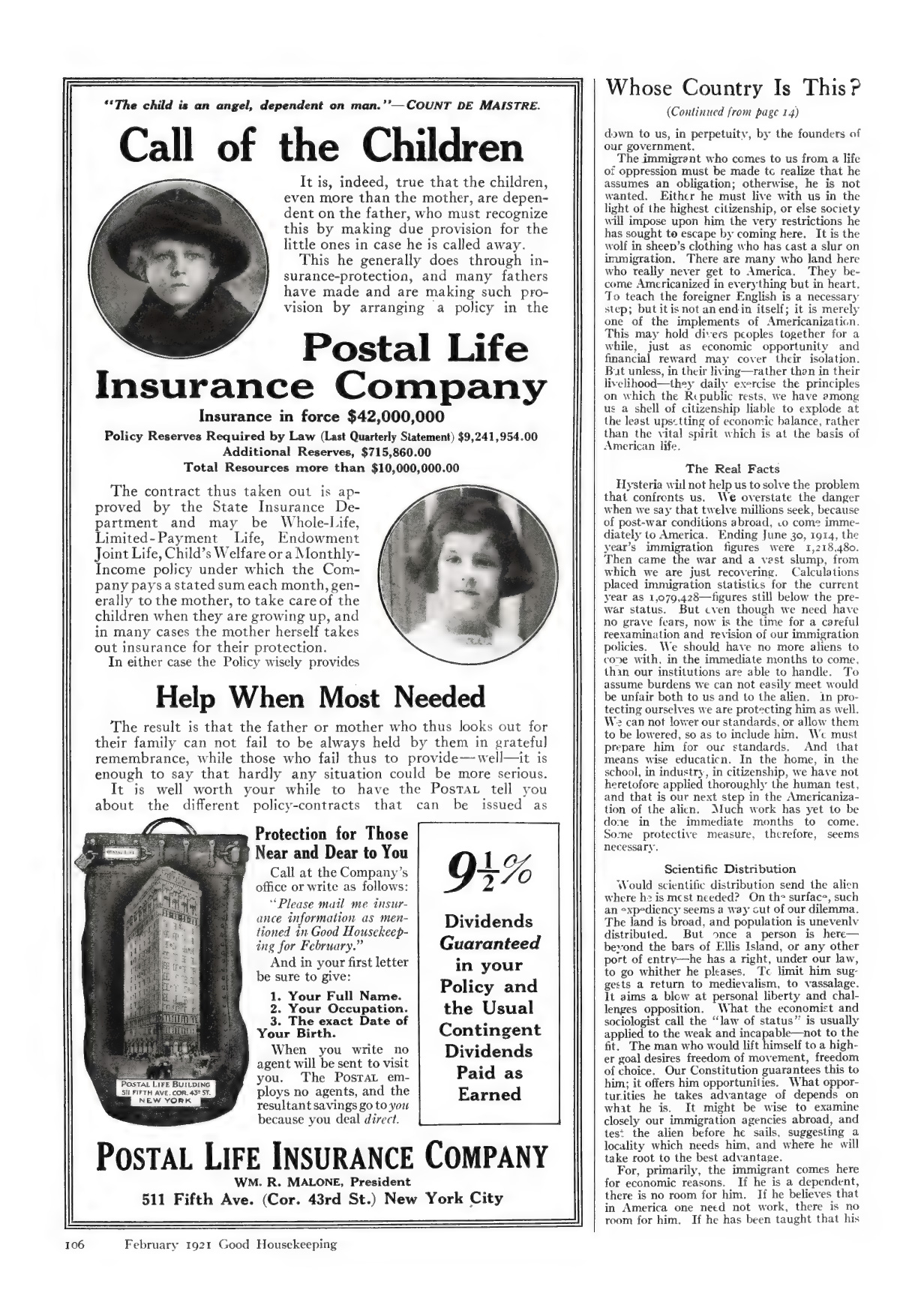
The immigrant who comes to us from a life of oppression must be made to realize that he assumes an obligation; otherwise, he is not wanted. Either he must live with us in the light of the highest citizenship, or else society will impose upon him the very restrictions he has sought to escape by coming here. It is the wolf in sheep’s clothing who has cast a slur on immigration. There are many who land here who really never get to America. They become Americanized in everything but in heart. To teach the foreigner English is a necessary step; but it is not an end in itself; it is merely one of the implements of Americanization. This may hold divers peoples together for a while, just as economic opportunity and financial reward may cover their isolation. But unless, in their living—rather than in their livelihood—they daily exercise the principles on which the Republic rests, we have among us a shell of citizenship liable to explode at the least upsetting of economic balance, rather than the vital spirit which is at the basis of American life.
The Real Facts
Hysteria will not help us to solve the problem that confronts us. We overstate the danger when we say that twelve millions seek, because of post-war conditions abroad, to come immediately to America. Ending June 30, 1914, the year’s immigration figures were 1,218,480. Then came the war and a vast slump, from which we are just recovering. Calculations placed immigration statistics for the current year as 1,079,428—figures still below the prewar status. But even though we need have no grave fears, now is the time for a careful examination and revision of our immigration policies. We should have no more aliens to cope with, in the immediate months to come, than our institutions are able to handle. To assume burdens we can not easily meet would be unfair both to us and to the alien. In protecting ourselves we are protecting him as well. We can not lower our standards, or allow them to be lowered, so as to include him. We must prepare him for our standards. And that means wise education. In the home, in the school, in industry, in citizenship, we have not heretofore applied thoroughly the human test, and that is our next step in the Americanization of the alien. Much work has yet to be done in the immediate months to come. Some protective measure, therefore, seems necessary.
Scientific Distribution
Would scientific distribution send the alien where he is most needed? On the surface, such an expediency seems a way out of our dilemma. The land is broad, and population is unevenly distributed. But once a person is here—beyond the bars of Ellis Island, or any other port of entry—he has a right, under our law, to go whither he pleases. To limit him suggests a return to medievalism, to vassalage. It aims a blow at personal liberty and challenges opposition. What the economist and sociologist call the “law of status” is usually applied to the weak and incapable—not to the fit. The man who would lift himself to a higher goal desires freedom of movement, freedom of choice. Our Constitution guarantees this to him; it offers him opportunities. What opportunities he takes advantage of depends on what he is. It might be wise to examine closely our immigration agencies abroad, and test the alien before he sails, suggesting a locality which needs him, and where he will take root to the best advantage.
For, primarily, the immigrant comes here for economic reasons. If he is a dependent, there is no room for him. If he believes that in America one need not work, there is no room for him. If he has been taught that his labor is a commodity for sale, he must learn that labor is no more a commodity than management. It is the product of labor, the product of management, that is put up for sale. In the last analysis, it is man’s intelligence that is purchased. Only in undeveloped countries can man be regarded as a beast of burden.
Intelligence is given every wise opportunity to develop. Unfortunate if it is overlooked by class consciousness. If labor’s fear of immigration is only a way of asserting, in an organized plea, labor’s right to monopoly, it must be remembered that such an attitude has never been successful, and will not be successful in this case. There are those who teach the laborer that the fewer hours he works, the better off he is. In order to maintain that belief, they have attempted, through organization, to dictate to government. This attitude is against public conscience, against the working of economic law. There was a time, in our country’s history, when we believed that leisure meant opportunity. But educated people soon found that opportunity lay not in leisure but in effort; so they went to work. The ideal for rich and poor alike is that any one, through honest effort, may assume and secure any position for which he is fitted.
Brains Are in Demand
It is a false doctrine that labor must assume all management. Those best suited for management must manage, whatever may be their source. Every industry is searching eagerly for brains. My observation convinces me that most business firms pledged to welfare work are interested in their employed; they often remain open in order to protect those who serve them, even though it might be more profitable for them to close down. People need to stop to think, when the laborer clamors against the unorganized labor market, whether the menace is from the immigrant or from some other source. For no business enterprise wishes its help to leave that it may employ others; the turnover is one of the most expensive things industry has to face. The expense of breaking in new help is appalling.
There is ample work for all in this country provided all will work. The problem of unemployment is aggravated, not wholly by the alien knocking at our gate, but by the laborer at home slamming the door of production behind him and walking out. Stopping industry will not right the matter. And in the last analysis it is the earnings of industry, which on the average are only fair, that provide alike for wages and the increase of investment on which is the sole dependence of the advance of civilization.
Safeguarding the Future
These are points to consider when we put our house in order for the advancing hordes of aliens. Experience has taught us to have faith in the bulk of our people. The great decisions in American history have always been right. The heart of the nation is sound and must be kept sound. It is a characteristic of ours that we are ashamed not to be right. I believe that our present concern about immigration is a fear that we will not be able to protect ourselves and at the same time discharge our obligations.
We must remember that we have not only the present but the future to safeguard; our obligations extend even to generations yet unborn. The unassimilated alien child menaces our children, as the alien industrial worker, who has destruction rather than production in mind, menaces our industry. It is only when the alien adds vigor to our stock that he is wanted. The dead weight of an alien accretion stifles national progress. But we have a hope that can not be crushed; we have a background that we will not allow to be obliterated. The only acceptable immigrant is the one who can justify our faith in man by a constant revelation of the divine purpose of the Creator.
Download the article: Whose Country Is This? by Calvin Coolidge
Photo in the public domain
“But there is no room for the alien who turns toward America with the avowed intention of opposing government, with a set desire to teach destruction of government—which means not only enmity toward organized society, but toward every form of religion and so basic an institution as the home.”

Leave a Reply