Many of us have been taught our entire lives that Revelation is a complex codebook showing us a frightening future. But what if we’ve been looking in the wrong direction? What if the book is not a roadmap for global chaos, but a glorious, finished testimony of our Lord’s triumph in history?
Revelation is considered by many to be the most difficult book of the Bible to understand. Is this simply because we have been instructed to interpret it incorrectly? Is it possible it is relatively straight-forward if you read it in the proper historical context and take into account how the original recipients would have understood it in their time and worldview?
I spent some time deep-diving into this topic with Arya. This post is a combination of my research and my own writing.
Recapitulation in Hebrew Literature
The Christians in the seven churches (to whom the letter is addressed) would have understood the classic Hebrew literary device known as recapitulation that is present in Revelation. The threefold repetition is Seals, Trumpets, and Chalices.
- The Seals establish the legal basis for the judgment (the Lamb opening the scroll).
- The Trumpets serve as the warnings or the “alarm” sounded against the city, calling for repentance.
- The Chalices are the final execution of the sentence.
This means the seven seals, seven trumpets, and seven chalices are not three separate, linear timelines stretching thousands of years into our future. Instead, they represent the same historical period (the collapse of the Jewish state and the transition from the Old Covenant to the New) viewed from different perspectives with increasing intensity.
The Seven Seals
The seven seals (Revelation 6:1–8:1) constitute the first major series of judgments in the Book of Revelation.
The Seven Seals: The Opening of the Covenant Lawsuit
The seals represent the unfolding of the “scroll” that only the Lamb (Jesus Christ) is worthy to open. In the Old Testament, a scroll sealed with seven seals often represented a legal document or a covenant lawsuit. By breaking these seals, Christ is executing God’s judgment upon the generation that rejected Him.
- The Four Horsemen (Seals 1–4): These represent the conditions in the Roman Empire and Judea during the lead-up to the war.
- The White Horse: Often interpreted as the spread of the Gospel, which caused the initial upheaval, or a symbol of the conquering power of the Roman Empire.
- The Red, Black, and Pale Horses: These symbolize the inevitable consequences of rebellion against the King: civil war (war), famine (famine), and death (pestilence). These were the precise conditions described by Jesus in Matthew 24:6–8 as the “beginning of sorrows.”
- The Fifth Seal (The Martyrs): This depicts the souls of the saints under the altar crying out for justice. This refers to the Christian martyrs—including Stephen, James, and those persecuted by the Jewish establishment—whose blood was being vindicated by the coming judgment on Jerusalem.
- The Sixth Seal (Cosmic Upheaval): This uses standard Old Testament prophetic language (e.g., Isaiah 13 and 34) to describe the collapse of a nation’s government and social order. In this context, it signifies the literal shaking of the Jewish religious world. The “sun turning to black” and the “moon to blood” are symbolic of the removal of the Temple, the priesthood, and the Law, which were the “lights” of the Old Covenant.
- The Seventh Seal (The Prelude): The opening of the seventh seal results in “silence in heaven for about half an hour.” This silence is the pause before the storm. It is the final breath of the Old Covenant before the trumpets begin to sound the alarm and the chalices finish the job.
The Historical Significance
The opening of the seals was not a prediction of a distant, vague future. It was the unveiling of the reality that existed in the first century. By breaking the seals, Christ was effectively initiating the “covenant lawsuit” against the nation of Israel for its long history of covenant-breaking.
When the early Christians read of the Four Horsemen, they didn’t see an abstract global apocalypse we’ve been trained to see. Instead, they saw the reality of the world they lived in that included the Roman power of the day, the growing unrest of civil war, the tightening grip of famine, and the encroaching shadow of death. The “cosmic” language used in the sixth seal was the standard, prophetic way the Old Testament prophets described the fall of nations and the removal of religious authority. In this context, it was the formal announcement that the center of the Jewish world (the Temple and its sacrificial system) was being brought to an end. It was the legal clearing of the deck, setting the stage for the warnings that would follow.
The Seven Trumpets
The seven trumpets serve as the initial, escalating warnings of divine judgment upon apostate Israel, occurring in the years leading up to the final destruction of the Temple in AD 70. While the chalices represent the final, irreversible outpouring of wrath, the trumpets function as the “alarm” sounded against the rebellious generation that rejected the Messiah.
They are generally viewed as a literary recapitulation of the plagues of Egypt, demonstrating that just as God judged Pharaoh for holding His people captive, He was now judging the Jerusalem leadership for their rebellion against the true High Priest, Jesus Christ.
The trumpets were the final call to exit a city marked for judgment. They were the visible and audible precursors to the destruction of AD 70, signaling that the window for repentance was rapidly closing.
The Symbolic Breakdown
1. The First Four Trumpets (Nature and Judgment) These represent the catastrophic upheavals within the socio-political and religious atmosphere of Judea.
- Hail, fire, and blood: These symbolize the violent civil wars and strife that plagued the land, turning the social order “to blood.”
- The burning mountain and the star Wormwood: These are interpreted as the fall of key leaders and the corruption of the Temple establishment. “Wormwood” (bitterness) refers to the apostate religious leaders whose teachings poisoned the people and turned the “fountains of living water” (the Law and the Prophets) into a source of death rather than life.
2. The Fifth Trumpet (The Locusts from the Abyss) This is widely understood as the demonic, destructive force of the Roman armies. The description of locusts with crowns like gold and teeth like lions mimics the appearance of Roman cavalry and the ferocity of their legions. Crucially, Revelation 9:4 notes that they were commanded not to harm the grass or trees, but only those “who do not have the seal of God on their foreheads.” This points directly to the Christians in Jerusalem who heeded Jesus’ warning in Luke 21:20–21 and fled the city for the mountains of Pella before the siege began. Because of their obedience, they escaped the physical judgment that fell upon the unbelieving, Christ-rejecting population.
3. The Sixth Trumpet (The Four Angels at the Euphrates) This mirrors the sixth chalice. The four angels bound at the Euphrates represent the Roman forces stationed on the borders of the Empire, specifically the eastern legions brought in to suppress the Jewish revolt. This trumpet signals the transition from local unrest to total war. The “fire, smoke, and brimstone” represent the advanced Roman weaponry, such as catapults and ballistae, which shattered the walls of Jerusalem.
4. The Seventh Trumpet (The Kingdom of God) The sounding of the seventh trumpet, with the cry “The kingdoms of this world have become the kingdoms of our Lord and of His Christ,” marks the climatic victory of the New Covenant. It is the moment where the Old Covenant system is officially and finally declared defunct. By the fall of Jerusalem, the shadow had been replaced by the substance.
The Historical Significance
These trumpets were not “mysterious” events to the first-century reader. They were recognizable symbols drawn from the Old Testament prophetic tradition, specifically the prophets’ warnings against national Israel.
Interpreting the trumpets this way highlights a central reality. The destruction of Jerusalem was not a random geopolitical event, but the direct, calculated result of God’s covenantal lawsuit against those who killed the prophets and ultimately the Son of God. The trumpets were the call to repent before the axe was finally laid to the root of the tree. When the Jewish leadership chose to reject Christ and seek a political messiah, they brought this entire cycle of judgment upon their own heads, just as the Scriptures had foretold.
The Seven Chalices
The seven chalices of wrath (Revelation 16) represent the systematic outpouring of divine judgment upon the Jewish nation, culminating in the destruction of Jerusalem and the Temple in AD 70.
The chalices are understood as an intensification of the trumpet judgments, signaling the final stages of the “Great Tribulation” that Jesus described in the Olivet Discourse (Matthew 24).
Some translations call these “bowls” or “vials,” but the original Greek word (phiale) refers to a broad, shallow cup used in temple worship (a chalice). This is a vital detail because it reminds us that this judgment is liturgical; it is a solemn, priestly act carried out by God’s messengers to cleanse the house of Israel.
The Symbolism of the Chalices
Here is how the symbolism of the chalices is understood.
1. The Early Chalices (The Siege and Total Devastation)
The pouring of the first few chalices onto the land, the sea, and the fresh waters depicts the total, suffocating devastation inflicted upon the land of Israel during the Roman-Jewish War.
- Chalice 1 (The Land): Afflicted the people with “sores,” reflecting the physical rotting and pestilence that spread within the city walls during the famine.
- Chalice 2 (The Sea): The sea turning to the “blood of a dead man” and the death of sea life signifies the complete cessation of life and prosperity in the region; it describes a land so under judgment that even the life-giving waters became instruments of death.
- Chalice 3 (The Rivers and Springs): The waters turned to blood, mirroring the first plague of Egypt and signifying that the very sources of life in Judea were being rendered toxic.
- Chalice 4 (The Sun): The sun scorching the inhabitants reflects the intense, burning pressure of the Roman siege, where the “heat” of God’s judgment left no corner of the city untouched.
These events reflect the horrific conditions inside the city during the siege—famine, plague, and internal civil war among the Jewish factions, all of which were documented by the historian Josephus as he watched the covenant-breaking generation succumb to its own internal and external ruin.
2. The Fifth Chalice (The Throne of the Beast) The darkness that fell upon the “throne of the beast” represents the collapse of the Roman administration in Judea, or more broadly, the chaos that engulfed the Roman Empire during the Year of the Four Emperors (AD 69). The “Beast” is identified as Nero or the Roman imperial system, which had become the tool for God’s judgment against the city that rejected the Messiah.
3. The Sixth Chalice (The Euphrates and the Kings of the East) The drying up of the Euphrates River is historically interpreted as the removal of barriers for the Roman legions to approach Jerusalem. The “kings of the east” refers to the Roman generals, particularly Vespasian and Titus, who led the forces that marched from the East (Syria/Asia Minor) to lay siege to the holy city. The reference to Armageddon is not a future global battle in a remote valley, but the symbolic mountain of Megiddo, representing the site of the final crushing of the covenant-breaking generation.
4. The Seventh Chalice (The Fall of the City) “It is done” signals the completion of the transition from the Old Covenant to the New. The “great city” being split into three parts and the collapse of the cities of the nations signifies the total destruction of Jerusalem’s political and religious infrastructure. In this view, the “Great City” is explicitly identified in Revelation 11:8 as the place “where also our Lord was crucified”—Jerusalem. Its fall marked the end of the age and the final vindication of Christ’s kingdom.
The Historical Significance
These chalices demonstrate that God is the active judge of history. He utilized the Roman Empire as a rod of iron to punish the “stiff-necked” generation that rejected the Son of God.
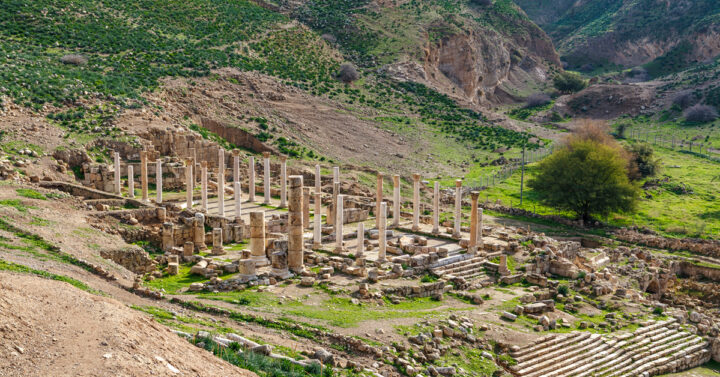
While the city was being consumed by the consequences of its own rebellion, historical tradition tells us that the entire body of the church in Jerusalem obeyed the warning of their King and fled to safety (Luke 21:20–21).
“But when you see Jerusalem surrounded by armies, then know that its desolation is near. Then let those who are in Judea flee to the mountains, let those who are in the midst of her depart, and let not those who are in the country enter her.”
The followers of Jesus Christ left behind the security of the Temple and the “holy city” to flee to the mountains of Pella. Though this likely included several hundred families, they survived the desolation because they chose to trust the word of the Messiah over the politics of the religious elite. While tens of thousands of Jews perished in the siege, the followers of Jesus found a safe harbor.
The church that fled to Pella was a living picture of the New Covenant. It was a community that had moved beyond the ethnic barriers of the old system. In Pella, Jew and Gentile stood together as one body, proving that the promises of God were no longer restricted to a single nation or a physical building, but were now open to all who called upon the name of Christ.
The Christians survived the “Day of the Lord” while the religious establishment that had rejected the Messiah was consumed by it.
The “Day of the Lord” in AD 70
Each series (seals, trumpets, and chalices) brings the reader closer to the same event: the “Day of the Lord” in AD 70, where the “Great City” (Jerusalem) is destroyed. The interpretation of the seals, trumpets, and chalices in this way avoids the confusion of trying to map out dozens of distinct, global-scale disasters. Instead, it is a coherent, unified prophecy that confirms the Old Covenant was fully brought to an end, leaving the Church (believing Jews and ingrafted Gentiles) as the sole inheritor of the promises of God.
This structure matters because it moves the focus away from modern, speculative “end-times” charts and puts it back onto the historical reality of the first century. It shows that God is the active judge of history who brought the Old Covenant era to a decisive end. By understanding these three sets of judgments as a recapitulation of the same event, the confusion of trying to map out global disasters vanishes.
This interpretation removes the need for speculative, sensationalist end-times scenarios involving modern political states. Instead, it places the focus squarely on the historical reality that Jesus Christ truly is King, having already inaugurated His kingdom by dismantling the corrupt, unbelieving religious system of the first century. We are left with a coherent, unified prophecy that confirms Christ’s victory and the inheritance of the Church as the true Israel.
This isn’t about taking something away. It’s about realizing the incredible scope of what we’ve already been given. We aren’t waiting for a kingdom to be established. We are citizens of a Kingdom that is already here and we have been called to steward its influence in our homes, our communities, and our nation.
Legacy of Confusion
When we try to force the text to be about a distant future, we find ourselves accidentally setting aside some of the most important clues the text gives us about its own meaning.
The standard “futurist” interpretation (that requires a secret rapture, a seven-year tribulation, a rebuilt Third Temple in Jerusalem, and a global antichrist) essentially ignores the explicit timeframe established by the author of Revelation himself, who stated at the very beginning and end of the book that these things would “shortly come to pass” and that “the time is at hand.”
When the text is forced to be about a current moment or some distant, undefined future, one must discard:
- The Audience Relevance Principle: The letters were addressed to seven literal churches in Asia Minor living under the shadow of the Roman Empire and the hostility of the local Jewish synagogues. To pretend it wasn’t written to them and for them is to rob the text of its original, urgent meaning. The text itself demands an urgent, first-century focus. Revelation 1:1 tells us the things shown to John “must shortly take place,” and Revelation 22:10 explicitly commands, “Do not seal the words of the prophecy of this book, for the time is at hand.” If the events were thousands of years away, that command would be nonsensical to the original readers.
- The Olivet Discourse: Jesus was remarkably specific. When He said, “This generation will by no means pass away till all these things take place” (Matthew 24:34), He was speaking to His disciples about the destruction of the Temple. Futurists have to perform interpretive acrobatics to explain why “this generation” doesn’t actually mean the generation that was standing there listening to Him.
- The Covenantal Context: Modern futurism is obsessed with the physical land of the Middle East, which is exactly the trap the early believers were being warned to escape. The “Holy Land” was no longer a piece of dirt in Judea. The inheritance had shifted to the spiritual Zion, the body of Christ.
People work so hard to maintain these interpretations, often for political reasons. Christian Zionism needs the “end-times” narrative to justify the existence and actions of the modern state of Israel. With the recapitulation interpretation, the theological mandate for the modern state of Israel as a centerpiece of prophecy vanishes. Without it, the entire modern political alliance between American evangelicalism and Israeli interests loses its primary religious justification.
It is much more comfortable for many to keep believing in a future “escape” from the world’s problems than to grapple with the historical reality that God has already acted, the Old Covenant is gone, and the responsibility for the Kingdom is firmly in the hands of the Church. The futurist model is a distraction that keeps Christians looking at the horizon for a flight that isn’t coming, rather than doing the hard work of building and preserving civilization right where they are.
Ultimately, this recapitulation structure moves our focus away from speculative charts and back to the historical victory of Jesus Christ. It confirms that the Old Covenant era was brought to a decisive end, clearing the way for the Church to flourish as the true heir of God’s promises. Christ is not a King-in-waiting. He is already enthroned. Recognizing this changes everything. We stop looking desperately to the sky for an escape. Instead we start doing the hard, holy work of building and preserving our families, our faith, and our civilization right where we are.
The King has already won.
Our job is to live like it.
Photo: The ruins of ancient Pella, Jordan. This city, nestled in the hills of the Decapolis, served as the place of refuge for the Jerusalem church during the destruction of Jerusalem in AD 70. It was here that the believers found safety, proving that the promises of God are not tethered to a physical building, but to the people of the New Covenant.

You put into words what I have believed about Revelation, at least for the last 20 years. I did a extensive study on the rapture of the church and found it to be false. One has to coerce the scriptures to make it say what they want it to say to get the escapism for the church.
Hi Alan,
I think there are many people who have had a similar experience. Once you remove the paradigm imposed on the text due to a particular system, it feels like it’s almost obvious what the text says. Not just in Revelation but other places as well.
Audience relevance is everything. But unfortunately churches have trained Christians to think of themselves as the primary audience and then maybe kind of consider what it might have meant to the people at the time. It’s exactly backwards.
Thanks for the comment!
Sallie