



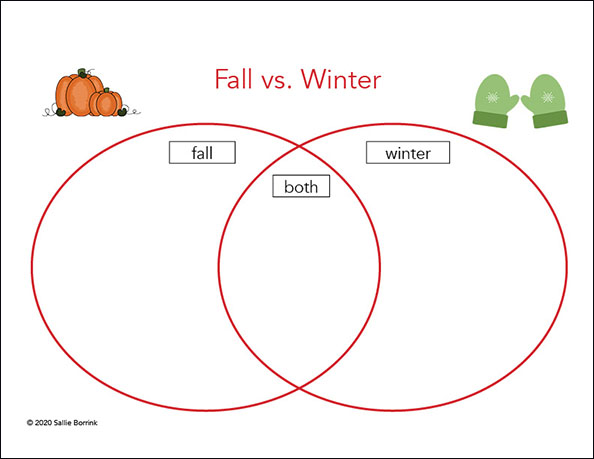
A Venn diagram is simply two ovals or circles that overlap and provide a visual way to learn. It helps a child see that two things can be different in some ways and the same in others.
That’s it. That’s the whole concept of a Venn diagram.
The diagram makes thinking visible for a child which can be incredibly helpful for some learners.
If you’ve never used one in your homeschool, you are in good company. Lots of homeschoolers haven’t discovered this great tool. Let’s talk about how to use this one.
How to Use the Fall and Winter Venn Diagram
Print – Use the free download link at the end of this post.
Discuss – Talk about fall and winter related things. This could include reading picture books.
Sort – As you talk, have your child decide whether something is only fall, only winter, or both.
Watch for the trickier items which can vary based on where you live. Rain could be fall and/or winter – or neither. Cold can be in both, but snow is probably not. This is where the real thinking happens so take the time to discuss some of the finer points rather than feeling you need to resolve every idea quickly.
Write – Have your child write or draw each item into the correct area of the diagram. Depending on age and ability, “writing” might mean dictating to you or writing it themselves. Remember most younger children know much more than they can physically write so writing it for them can be very appropriate if the goal is learning and not the physical act of writing.
Why This Is Worth Doing
Here are a few reasons why a Venn diagram is so practical.
It builds classification skills. Sorting is foundational. A child who can sort and re-sort objects by different criteria is building executive function, which underpins nearly everything else.
It supports visual-spatial learners. A Venn diagram is a picture of a thought. For a child who thinks in pictures rather than paragraphs, this is a welcome change of pace and it often turns into a gateway to writing, because once the child can see the relationship, the words come easier.
It teaches “and” instead of “or.” So much of a child’s early reasoning is binary: this or that. The overlap circle introduces a third possibility — both this and that at once — which is a rather sophisticated idea for a six-year-old to hold.
It’s low-prep and low-pressure. One printable, one book, one discussion, one afternoon. No answer key. No curriculum. Nothing to buy.
It scales to your child’s ability. The same diagram works for a kindergartener coloring in shapes and a twelve-year-old writing an essay about what fall and winter have in common.
It’s a good group activity. Put one diagram in the middle of the table and have your children sort together. The discussion and reasoning is part of the learning.
Free Download
Enjoy learning with this free Venn diagram!
By downloading this free printable, you are agreeing to my Digital Products Terms of Use. Thank you for respecting my work!
Download the Fall and Winter Venn Diagram
Looking for more free learning printables? You’ll find more ideas here: Free Homeschool Printables.

Leave a Reply