








I left a comment on my post Were the Apostles Wrong About Jesus’ Return? in which I said I would expand on this topic in a full post. As it turns out, it worked better to put it into two posts.
The first expansion is in this post: The World (oikoumené) in the New Testament.
In this second post, I’d like to briefly recap oikoumené and then move on to the main question here.
However, if you haven’t read the post about oikoumene, then I strongly suggest you do that first because you will get much more out of this one.
So what is the main question in this post? It is this.
According to the writers of the New Testament, has the gospel been preached to all the nations? If so, when?
This might sound like a crazy question because we have been taught that every people group on every square inch of the earth has to hear the Gospel in their own language before Jesus can return.
But what if that is a wrong interpretation of the New Testament?
The question is what the original writers of the New Testament would have thought when writing and what the original recipients thought when they received the inspired writings.
The Whole World = oikoumene
Here are a few examples of the world (“the whole world” = oikoumene). You can find more in the post I linked above.
Here is what Jesus said in that pivotal verse in Matthew 24.
And this gospel of the kingdom will be proclaimed throughout the whole world (oikoumené) as a testimony to all nations, and then the end will come. (ESV)
And this gospel of the kingdom will be preached in all the world (oikoumené) as a testimony to all nations, and then the end will come. (BSB)
And this gospel of the kingdom shall be preached in all the world (oikoumené) for a witness unto all nations; and then shall the end come. (KJV)
Matthew 24:14
Oikoumene means the whole inhabited world which at that time was the Roman Empire. (See the previous post for more details.)
Luke also uses oikoumene.
And it came to pass in those days, that there went out a decree from Caesar Augustus, that all the world should be taxed. (KJV)
“In those days a decree went out from Caesar Augustus that all the world should be registered.” (ESV)
“Now in those days a decree went out from Caesar Augustus, that a census be taken of all the inhabited earth.” (NASB)
Luke 2:1
We know from the context that “the whole world” was the Roman Empire. I’ve never heard anyone tell the Christmas story and say all of the people across the entire Earth were included in this census.
So Luke used the same word in the census story that Jesus used when telling the disciples when the end would come.
Interesting, isn’t it?
The Gospel in the Whole World
Would it surprise you to learn that the Christians in the early church believed the Gospel had been preached to the whole world?
There are other New Testament passages that do not use the word oikoumene, but the writers affirm that the Gospel has been preached to the whole world.
Paul starts his letter to the Romans with this.
First, I thank my God through Jesus Christ for you all, that your faith is spoken of throughout the whole world. (KJV)
First, I thank my God through Jesus Christ for all of you, because your faith is proclaimed in all the world. (ESV)
Romans 1:8
In the letter to the Colossians, Paul also references the Gospel going out in all the world.
…which has come to you, as it has also in all the world, and is bringing forth fruit, as it is also among you since the day you heard and knew the grace of God in truth (NKJV)
…which has come to you, as indeed in the whole world it is bearing fruit and increasing—as it also does among you, since the day you heard it and understood the grace of God in truth (ESV)
Colossians 1:6
Paul says this later in Romans.
but has now been disclosed and through the prophetic writings has been made known to all nations, according to the command of the eternal God, to bring about the obedience of faith… (ESV)
but now has been disclosed, and through the Scriptures of the prophets, in accordance with the commandment of the eternal God, has been made known to all the nations, leading to obedience of faith… (NASB)
Romans 16:26
In 1 Timothy, Paul writes this.
By common confession, the mystery of godliness is great: He appeared in the flesh, was vindicated by the Spirit, was seen by angels, was proclaimed among the nations, was believed in throughout the world, was taken up in glory. (BSB)
And without controversy great is the mystery of godliness: God was manifested in the flesh, Justified in the Spirit, Seen by angels, Preached among the Gentiles, Believed on in the world, Received up in glory. (NKJV)
Without question, this is the great mystery of our faith: Christ was revealed in a human body and vindicated by the Spirit. He was seen by angels and announced to the nations. He was believed in throughout the world and taken to heaven in glory. (NLT)
1 Timothy 3:16
In Acts, Luke writes this.
Now there were dwelling in Jerusalem God-fearing Jews from every nation under heaven. (BSB)
And there were dwelling at Jerusalem Jews, devout men, out of every nation under heaven. (KJV)
Now there were dwelling in Jerusalem Jews, devout men from every nation under heaven. (ESV)
Acts 2:5
Christians in the New Testament believed the Gospel HAD been preached to the whole world. That’s why when Jesus said he was coming soon, they believed that He meant exactly what He said.
The question I think Christians should be asking themselves today is why we ignore the straightforward explanation of these passages. Why do we labor to develop something much more complicated that contradicts Jesus and the apostles who were with him?
Is it possible we have this wrong? If we have this wrong, what else is wrong about how we read and understand the related topics?
Now go back to this. Jesus said:
And this gospel of the kingdom will be preached in all the world (oikoumené) as a testimony to all nations, and then the end will come. (BSB)
The end of what?
In the proper context, what is Jesus saying will end?
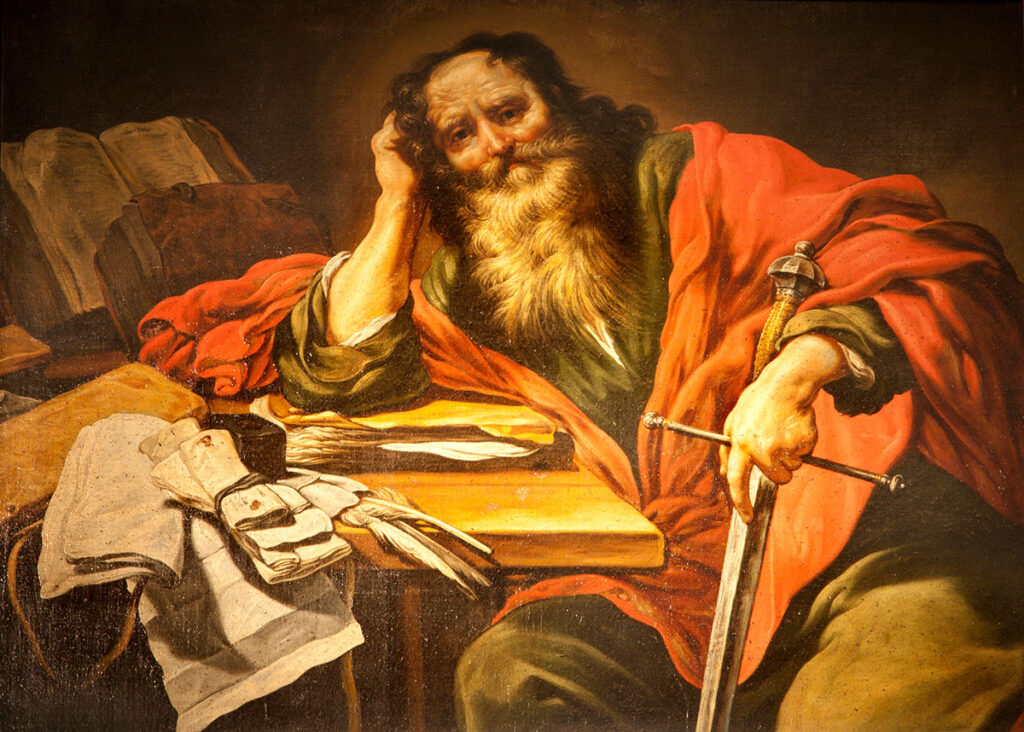
Saint Paul Painting from Paris – St. Severin Church

 Make the Big Change | Cozy Life Reset – Day 23
You are so right. My husband pointed that out to me that the whole world was applying to the Roman Empire. He also pointed out that referring to the flood.
Hi Sherry,
I’ve seen a similar argument made about the flood, but my basic level understanding leads me to see it as an apples and oranges comparison. I haven’t done a deep dive into the Flood so until I do I still land on the world-wide flood. I’ve seen too much archaeology and such to convince me otherwise at this point. The proliferation of flood stories around the world is also striking to me.
So many things to study, so little time…
Sallie